There has to be a first time for everything. Nothing in this world began without its very first time.
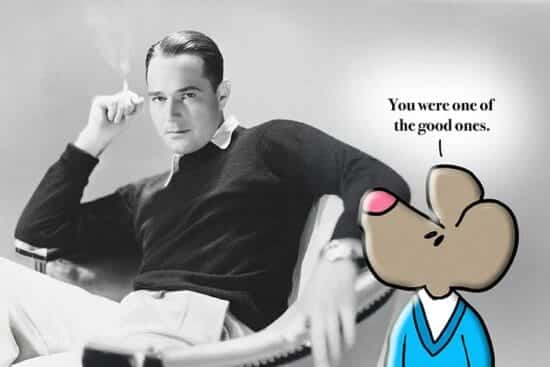
So with that, I bring you William Haines. You may not know his name, but he was Hollywood’s first out gay superstar.
William Haines was sure he’d be fired one day. He worked as an errand runner for a financial office in New York City in the early 1920s. He was in his mid-20s at the time and didn’t have such a great work ethic. He admitted this himself. If he were given a task by his employer, he would end up wandering about the city instead.
But fate intervened. One day, a woman accosted him on the street and asked if he had ever considered being in the movies. Haines had never considered this. At all. But he decided to explore the opportunity and followed her directions to an address where he got a screen test.
And look what happened.
Within five years, he was considered one of the top box office attractions in America.
For those who followed Haines in the press, certain words and phrases kept cropping up. He was a “bachelor,” journalists wrote. And the studio bigwigs insisted he “lacked sex appeal.”
As a result, his roles always slotted him into a wisecracking screen persona.
But underneath it all, Haines was a gay man in both a business and an era that was intolerant of that. Even so, he made no effort to conceal it in Hollywood circles. He was gay. He knew it. And that was that.
Despite his refusal to “hide” his sexuality, which was a standard in those days, his career ascended. But eventually, he was forced to choose between his further success and staying true to himself. Haines’s decision would affect him for the rest of his life.
William Haines was a rising star. He was a tall, charming, and quick-witted leading man who didn’t bother to hide the fact that he was gay. He met his lifelong partner, Jimmie Shields, in 1926 and brought him to Los Angeles, where the two became fixtures in Hollywood’s social scene. The two of them were quite the thing, mingling with Joan Crawford, Mary Pickford, and other A-listers.
In an era when studios demanded strict morality clauses and the newly enforced Hays Code banned the portrayal of homosexuality, Haines stood out for refusing to play the game. While other actors agreed to “lavender marriages” to keep their careers safe, he flat-out told MGM co-founder Louis B. Mayer “no.” That decision effectively ended his acting career.
For those who don’t know (and I didn’t) the Hays Code was Hollywood’s first big set of content rules. It was a kind of moral rulebook for movies. It went into effect in 1930.
The code outlined what could and couldn’t be displayed on screen. Among the “can’t do” list:
No nudity or “suggestive” dancing
No profanity
No drugs or “excessive” drinking
No ridicule of religion
No interracial relationships
No “sexual perversion” (their coded term for homosexuality)
Criminals couldn’t be shown getting away with their crimes
No scenes deemed to “lower the moral standards” of the audience
So there were those guidelines. Some are good ones, I think. Others might be a bit lacking.
The Hays Code aside, our man Haines didn’t look back. He and Shields built a thriving interior design business. They worked for the biggest stars and even for some of the same studio heads who’d pushed him out of films.
Despite the terrible treatment from the outside world, Haines and Shields remained together for nearly 50 years until Haines’s death in 1973.
I admire the people who were so brave in their lives. He was one of them.
“””””””
“The privilege of a lifetime is to become who you truly are.” — Carl Jung
“””””””
“To be yourself in a world that is constantly trying to make you something else is the greatest accomplishment.” — Ralph Waldo Emerson
“””””””
“The most courageous act is still to think for yourself. Aloud.” — Coco Chanel
“””””””
“There is no remedy for love but to love more.” — Henry David Thoreau
“””””””