Little packets, I’ll tell you. That’s what is at the core of this little thing we call the Universe.
Here’s what I’m talking about.
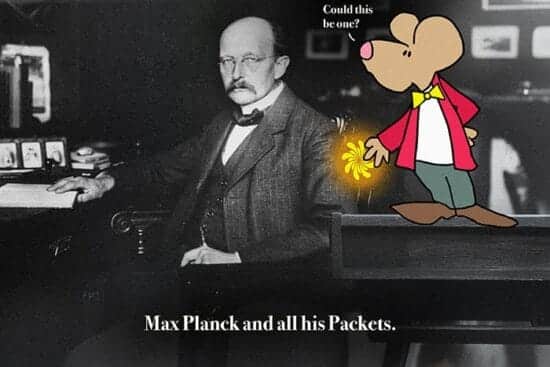
On December 14, 1900, a German physicist named Max Planck changed the way we see the Universe.
Good old Max wasn’t setting out to rewrite the rulebook of physics. He was just trying to solve a puzzle about how radiation behaved on a “blackbody” substance.
Just for the record: A blackbody is an object that absorbs all radiation (light, heat, energy) that falls on it. Think of it this way. If you heat up a piece of metal, it glows red, then orange, then white. That’s blackbody radiation at work.
Anyway. Back to Max. What he found was something far bigger.
Through his experiments, Planck discovered that energy doesn’t always behave like a smooth, continuous wave. This is how all the old classical physics had been taught. The wave thing.
Instead, in certain situations, energy shows up in tiny, measurable packets. Yes. Packets. And Max called them quanta. That one idea cracked open a whole new way of thinking about light, heat, and even matter itself.
Max Planck’s breakthrough solved mysteries that had stumped scientists for years. Like this. They wondered why solids glow the way they do when heated. They also wondered how atoms absorb light. Max’s work helped everyone to understand these things.
And in 1918, the world recognized just how monumental this was when Planck received the Nobel Prize in Physics for his work on blackbody radiation.
But the story didn’t stop with him. Other scientific heavyweights, like Einstein, Bohr, and Schrödinger, picked up the torch.
These guys expanded Planck’s insight into what became known as quantum mechanics. It is a bit mind-bending. It is basically a framework where energy can behave like both a particle and a wave, depending on the conditions.
Classical mechanics tells us that the world is predictable and orderly. But quantum mechanics embraces probabilities and uncertainty. It also consists of a reality that’s much stranger than it looks. Oftentimes, I can’t even wrap my head around it. Uncertainty everywhere.
But here is the main thing about all of this. The union of Planck’s quantum theory with Einstein’s theory of relativity forms the backbone of modern physics.
We take a LOT of technology for granted. From semiconductors to lasers to MRI machines. But all of this exists because, back in 1900, Max Planck decided to take a closer look at a glow no one could quite explain.
Sometimes the biggest revelations start with the smallest questions.
“””””
“Anyone who is not shocked by quantum theory has not understood it.” – Niels Bohr
“””””
“The very small is never to be despised. A tiny change may open the way to a new world.” – Max Planck
“””””
“Somewhere, something incredible is waiting to be known.” – Carl Sagan
“””””