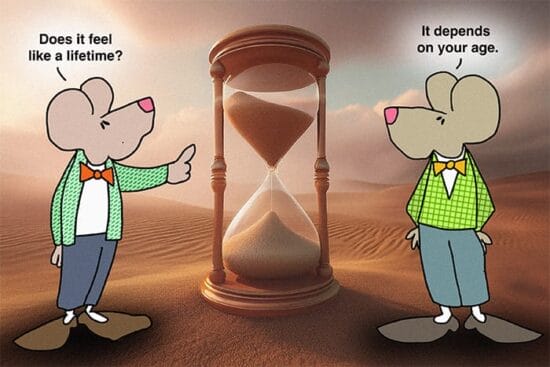
I was thinking about time this morning. I often do.
Part of being alive is the phenomenon we know as “the passage of time.” Without it? We would no longer be.
So. Why does time feel different as we age?
We remember. Being five years old and waiting for Christmas to come. Nine days away? What? That’s a lifetime, we thought.
Well. As it turns out, that is partially correct.
There are several “reasons” why time goes faster as we age. First is the Proportional Theory.
When we’re 5 years old, one year is 20% of our lives. At 50, it’s just 2%. So each year feels proportionally “smaller” compared to our total lived experience.
Next is our Memory Density (Novelty Effect).
We remember this, too. It seems that our childhoods are full of “firsts.” There is our first bike ride, first day of school, first trip to the ocean. Our first peanut butter and jelly sandwich.
Novel experiences make stronger, more detailed memories. The brain encodes more information, so that time feels fuller and longer when recalled.
As adults, our days are often more routine. We move through all those familiar things of our every day occurrences. Housework, business work, dinner, sleep. So fewer unique memory “bookmarks” are laid down. It all becomes a mindless blur. And. Looking back, those weeks feel compressed and speedy.
The next reason has to do with attention and focus.
Kids live more “in the moment.” Their attention isn’t split between a dozen tasks. This slows down their perception of time. As adults, we multitask, automate, and daydream, which makes the hours slide by unnoticed.
Finally, we have those neurological changes that happen in our brains.
Research suggests that dopamine, which helps regulate time perception, decreases with age. Lower dopamine levels may contribute to a sense of time passing faster. Dope.
It all begs the question. Can we slow it down?
Scientists say that we can stretch out our sense of time if that is what we want. We can do it in several ways.
Like. Add newness to our lives. We can take a new route, try a new recipe, or learn a skill. When we do this, our brains lay down richer memories.
Also. Mindfulness. When we pay close attention to the world around us, like really tasting our coffee, noticing the sky, and taking a deep breath, it increases memory density for even small moments.
Perhaps if we want life to feel longer and more, we might try living like a kid again. That means being full of curiosity, “firsts,” and noticing details. Learning.
“”””””
“Time moves in one direction, memory in another.” — William Gibson
“”””””
“Time is an illusion.” — Albert Einstein
“”””””
“How did it get so late so soon?” — Dr. Seuss
“”””””