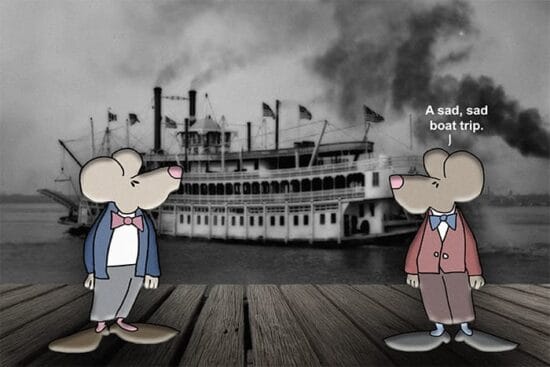
I’ve only been on a riverboat twice.
The first time was for the Stacks event in Cincinnati. I don’t remember too many of the details from that day. It was more than 25 years ago, back in the days when I still drank an alcoholic beverage or two, or nine, or fifteen. I do remember it was a very fun day.
The second time is when my brother, sister, and I took our parents for a riverboat ride on the Ohio River. I don’t think it could even be considered a real riverboat. It was more of a tourist thing. I think the paddlewheel was fake, as I recall. It just churned water. Anyway. We boarded in Cincy, went up the river for an hour or two, turned around, and came back.
But once upon a time, riverboats were the real deal.
There were a lot of riverboats in history, especially during the 19th and early 20th centuries, when rivers were the highways of commerce and leisure.
The Mississippi, Ohio, and Missouri Rivers became the greatest corridors of riverboat traffic. By the 1830s–1850s, thousands of steamboats were in operation. Can you imagine?
At the peak (around the 1850s), there were estimated to be over 700–800 steamboats on the Mississippi system alone, constantly moving freight, cotton, timber, and passengers.
They weren’t just workhorses—many were floating palaces, with dining halls, music, and elaborate decks for socializing. They were as much a cultural icon as a mode of transport.
But it wasn’t all good news for those riverboats. Sometimes, there were tragedies.
On June 15, 1904, New York City witnessed one of the deadliest maritime disasters in American history. The riverboat General Slocum caught fire on the East River. It took less than an hour for more than a thousand lives to be lost.
The day began as something joyful. The St. Mark’s German Lutheran Church had planned its annual Sunday School picnic. All sorts of families boarded. There were mothers, teachers, and children. It was supposed to be a fun day. People were smiling. Spirits were high.
So at nine in the morning, the General Slocum set off, carrying 1,360 passengers.
But only a couple of minutes later, tragedy struck. One of the kids on the boat noticed smoke curling out of a storeroom. She tried to find someone who would listen to her about that smoke.
Sure enough, where there is smoke, there is fire. The fire, fueled by oil and wood shavings, spread with terrifying speed.
The crew discovered too late that the hoses didn’t work. To make matters worse, the lifeboats were tied down so tightly they couldn’t be freed. And finally, the life preservers were stuffed with useless, heavy material that dragged children under instead of keeping them afloat.
The captain, a man named William Van Schaik, was trying to deal with all the chaos. He chose to steer toward an island in the river rather than the nearest dock.
His decision sealed the fate of many. Instead of grounding safely, the boat smashed into rocks. Flames consumed the decks. The passengers were trapped. And of course, a great deal of panic surged through the crowd. Some were trampled, others drowned, and entire families were lost in the recklessness.
By the end, 630 bodies were recovered. Another 401 were missing. The entire city of New York was shaken.
It was a mess. A cannon was even fired over the river the next day to dislodge bodies from the mud.
The aftermath was bitter. The boat’s owners and inspectors were charged, but only Captain Van Schaik served prison time. He was later pardoned due to old age. President Theodore Roosevelt fired the chief inspector of the Steamboat Service, and stricter safety regulations followed.
In Queens, a mass grave became the resting place for many victims. This tragedy tells a tale of the fragile line between happiness and sorrow. The General Slocum also tells the story of negligence and loss.
But one thing is sure. There were changes born out of that tragedy. Laws and practices were put into place to make sure this sort of thing didn’t happen again.
Safety measures we often take for granted today have often come about because of a terrible cost. In all areas of life. From boat safety to vaccinations to ward off polio and measles, and more.
Perhaps that is the quiet lesson. We should give thanks for the protections we have now, and the responsibility to make sure such failures never happen again.
“”””””
“History is a vast early warning system.” — Norman Cousins
“”””””
“We learn from history that we do not learn from history.” — Georg Wilhelm Friedrich Hegel
“”””””
“Negligence is the rust of the soul, that corrodes through all her best resolves.” — Owen Feltham
“”””””
“Pain is never wasted. It brings lessons we would not have learned any other way.” — Phillip Berry
“””””””