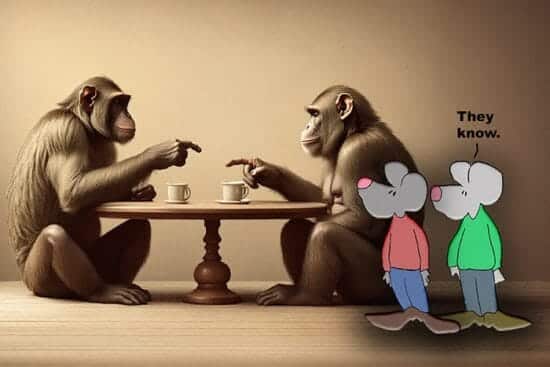
Snacks. Even the word, the very sound of it, is enchanting.
I love it when someone says, “I think I’ll have a snack.” It simply has a magical ring to it.
Of course, we all eat our meals throughout the day. It is how we stay alive. But in between those meals, we often get a hankering. And that is when we call upon the snack.
But perhaps there is a problem, and we don’t know where the snacks are. So a good friend points us in the right direction. That simple moment, when we recognize what someone else doesn’t know and we act to help, is part of what psychologists call “theory of mind.”
Theory of mind.
(And you thought today’s blog was going to be about peanut butter and jelly sandwiches, or potato chips and dip.) But alas.
Back to it. Theory of mind.
For years, we’ve wondered: Do our great-ape cousins have it, too?
Well. A new study says yes. At least. Some bonobos do.
Cognitive scientists Christopher Krupenye and Luke Townrow (Johns Hopkins University) worked with three bonobos. The apes’ names were Nyota, Kanzi, and Teco. All this happened at the Ape Initiative in Iowa.
The setup was charmingly low-tech. There was a treat hidden under one of three cups near Scientist Luke Townrow. Sometimes he saw where the treat went; sometimes he didn’t. Here’s the twist to the study. The bonobo only got the goodie if Townrow handed it over.
When Townrow knew the location, the apes typically waited him out. But when he didn’t know the location, the bonobos pointed quickly and more often to the correct cup. They were essentially saying, “Hey buddy, it’s right there.” In other words, they adjusted their communication based on his knowledge, not just their own desire for grapes. That’s a big deal. Theory of mind.
Scientists have seen hints of this before in the wild. It happens when chimpanzees warn group mates who haven’t noticed a nearby threat. But this controlled study shows bonobos proactively helping an ignorant partner succeed. The study found that these apes can hold two realities at once:
I know where the food is, and
I know you don’t.
Why does this even matter? Well. It is pretty dang big if you ask me. If both humans and other great apes can track each other’s ignorance, that ability likely started with a shared ancestor millions of years ago.
But. More than that. It nudges us toward a humbling insight. These apes are incredibly intelligent in social language. Also. Complex language isn’t required for this kind of social intelligence. Pointing done at the right moment can be plenty.
The message from Nyota, Kanzi, and Teco is wonderfully clear. They have shown that empathy and cooperation might be more universal than we thought. And it exists in more creatures than just humans.
And. This.
Today, most of us will feast on meals without having to guess which cup it is under.
May we all bask in the goodness of this.
But also to the gratitude for these gifts and for the kindness toward others.
“””””””””
“Could a greater miracle take place than for us to look through each other’s eyes for an instant?” — Henry David Thoreau
“””””””””
“The greatest gift you can give another is the purity of your attention.” — Richard Moss
“””””””””
“We think we listen, but very rarely do we listen with real understanding.” — Carl Rogers
“””””””””
“Sharing food is the most intimate act of all. A snacker knows this truth by heart.” — Laurie Colwin
“””””””””