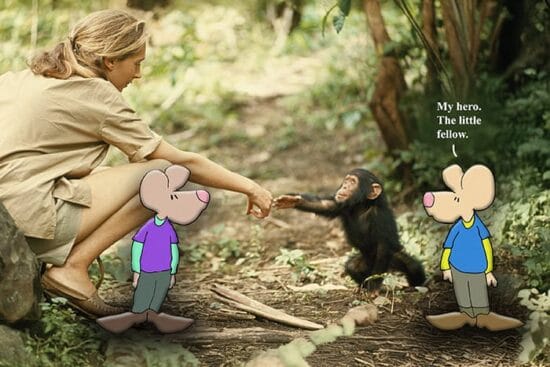
They say we should never meet our heroes.
There is a song by Jill Sobule called Heroes. It addressed this topic, saying, “The statue in the park has lost its crown.”
But we all have our heroes, don’t we? Perhaps we don’t call them that. But they are those good people whom we respect and admire. I have a lot of people in my barrel of heroes.
One of them was Jane Goodall. She died recently, on October 1, 2025, at the age of 91. She did good things throughout her entire life. Of course, we all know her for her work in animal research. Goodall transformed how the world sees chimpanzees. She began her research in Gombe, Tanzania, in 1960.
When she started, scientists didn’t even name their study animals. They simply numbered them. Jane named hers and observed those chimps as individuals with personalities, emotions, and social structures.
Her discoveries were groundbreaking, especially the fact that chimpanzees knew how to make tools and use them.
But she was much more than that. She inspired a global movement for environmental stewardship. And she helped shift public attitudes toward animal rights and also conservation.
Maybe more than anything, she showed that curiosity, patience, and compassion can change the world.
The thing is, her observations of the world were more profound than anything. She once said:
“You cannot get through a single day without having an impact on the world around you. What you do makes a difference, and you have to decide what kind of difference you want to make.”
She also said this: “We are part of the natural world. And even today, when the planet is dark, there is still hope. Don’t lose hope. If you lose hope, you become apathetic and do nothing. And if you want to save what is still beautiful in this world – if you want to save the planet for the future generations, your grandchildren, their grandchildren – then think about the actions you take each day.”
Jane Goodall’s words remind us that hope isn’t just a feeling. She tells us it is a responsibility. She spent a lifetime watching the fragile balance of the natural world. She witnessed so many hard things like deforestation, vanishing species, greed, and violence. Yet. She still urged us not to give up. That carries a lot of weight.
She tried to tell us that we belong to the world we’re trying to save. The forests, the oceans, the air we breathe. We are all a part of it. Those things are not separate from us.
And while it’s easy to feel overwhelmed by the planet’s “darkness,” Goodall reminds us that what we do each day matters. Every little thing. The way we consume. The things we choose. The way we vote. It all matters. What we do can either contribute to the harm or become part of the healing.
The thing that most stood out to me was this. When we lose hope, we stop acting. Apathy is what allows destruction to continue. Hope, on the other hand, fuels movement. Even when it takes place in the smallest of acts that ripple outward. I don’t think that hope is blind optimism. Instead, it is choosing to believe that what’s still beautiful in this world is worth the effort.
We should always participate. However, it might be that we are able.
“”””””
“The greatest danger to our future is apathy.” — Jane Goodall
“”””””
“We need another and a wiser and perhaps a more mystical concept of animals.” — C.S. Lewis
“”””””
“Until one has loved an animal, a part of one’s soul remains unawakened.” — Anatole France
“”””””
“Research is to see what everybody else has seen, and to think what nobody else has thought.” — Albert Szent-Györgyi
“”””””