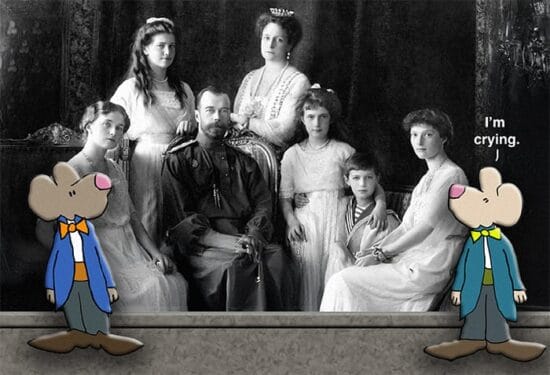
A lot has happened in Russia over the years.
But perhaps one of the most notable stories is about the royal Romanov family.
Most of us know the Romanovs as a tragedy. They were a doomed imperial family. They were overthrown by revolution. But I don’t think they asked for this. At all.
Before they became a part of a royal dynasty, they were simply a family. A real one. They were probably the same as many of us. The told jokes, experienced heartbreaks, had inside nicknames, shared their favorite meals, and so much more.
But here is how it went for them. Nicholas II became emperor in 1894. It was a job he never wanted. He openly feared he couldn’t handle the position. But he was thrust into that place.
The one thing he never doubted was his love for Alexandra. Their marriage wasn’t arranged, like so many others in that day. No. They had a rare loyal love match. She called him “Nicky” and “my lovebird.” He called her “Sunny.”
After their wedding night she scribbled in his journal, “Never did I believe there could be such utter happiness in this world.” Yes. They loved each other. They were happy.
Of course, loving like that means they got busy. They had five kids as a result. Their five children made up a lively household. But at the same time, it was a bit complicated. Olga was thoughtful and romantic. Tatiana, steady and capable. Maria, gentle and often teased. Anastasia seemed to be the wild spark plug. And then there was Alexei, the fragile heir to the throne. But he had hemophilia and this brought constant danger. Pain was a daily reality for him. His only relief was fainting. Everyone in the family adored him fiercely.
What’s easy to forget is how normal they tried to be. During World War I, Alexandra, Olga, and Tatiana trained as Red Cross nurses. They tended wounded soldiers day after day. Anastasia and Maria visited patients, read to them, and wrote their letters.
Even in captivity, the family insisted on their small rituals. They crafted handmade Christmas gifts. They knitted waistcoats, painted ribbons, and little things like these to keep their disrupted world intact.
Anastasia, true to form, brought mischief even behind barbed wire. Her humor was completely infectious. One day during a makeshift play, Alexandra nearly collapsed laughing at her. It was said that her wit helped the family “keep their spirits up.”
And through it all, the family tried to be kind, even to the guards who jeered at them.
To remind you of their last fateful days.
The fall of the Romanovs came swiftly and brutally after centuries of imperial rule. In the early morning hours of July 17, 1918, Tsar Nicholas II, his wife Alexandra, their five children, and several loyal attendants were awakened in the house where they’d been held under guard in Yekaterinburg.
They were told they were being moved, but instead were led to a basement room under the pretense of safety. Moments later, a Bolshevik firing squad entered and read a brief execution order.
The family barely had time to react before gunfire erupted. The room filled with smoke and bullets ricocheted off their bodies. Confusion turned the execution into a chaotic and violent scene.
By the end of it, the entire immediate Romanov family was dead. This marked both the collapse of the Russian monarchy and the rise of a radically new era.
History usually remembers how the Romanovs died. But a great part of their lives were lived in kindness. The carried on, day to day, tenderly, imperfectly, and wholly human.
“””””
“History is not what happened. History is what survives the telling.”
— Jill Lepore
“””””
“Perhaps somewhere, someplace deep inside your being, you have undergone important changes while you were sad.”
— Rainer Maria Rilke
“””””
“Empires fall, love remains.”
— Henry Fairchild
“””””
“No one really dies unless they are forgotten.”
— Jorge Luis Borges
“””””