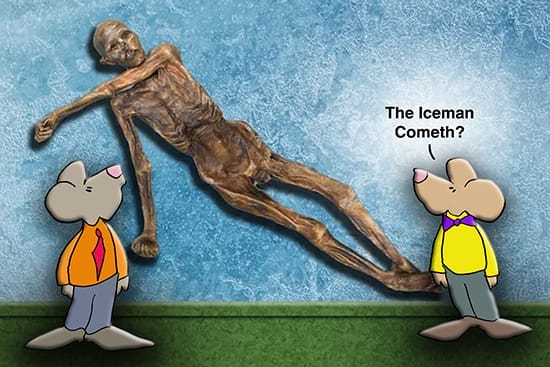
Ötzi the Iceman. Here he is.
But first. I like the great outdoors. I like to hike. But whenever we head out and explore this way, we have to remember that anything can happen.
A case in point? This. A few hikers stumbled upon a frozen body high in the Tyrolean Alps back in 1991. They had no idea they were meeting one of the most fascinating figures in archaeology.
His name was Ötzi the Iceman, or so we call him. This guy was 5,300 years old. He was remarkably preserved. These days, he is a bit of a scientific celebrity, and he continues to surprise the world even decades after his discovery.
Here is the thing. One of the most curious features on his body? Sixty-one tattoos. They are all over his skin. I have two tattoos. I have a lot of catching up to do if I want to be like Ötzi.
Obviously, he did not get these tattoos like we do today with an electric device. For years, researchers believed his tattoos were made by cutting the skin and rubbing pigment into the wounds. But new research suggests something very different.
A team led by an archaeologist named Aaron Deter Wolf now believes the tattoos were created in a way that is actually sort of similar to how we do it now. They think people used a single-point puncture tool dipped in carbon pigment.
Deter Wolf consulted with professional tattoo artists. The experts immediately recognised that the lines did not look cut. Instead, they showed the rounded edges and subtle stippling that come from a series of tiny punctures. Researchers have studied this for decades.
Most of Ötzi’s tattoos appear on areas where he likely experienced pain. They are found mostly on his lower back, knees, ankles, and wrist. Researchers believe the markings may have been therapeutic. Like a sort of prehistoric form of acupuncture.
But that is not the whole story. Symbolism may have been a reason, too. It seems we humans rarely do anything only for practical purposes.
Of course, Ötzi’s story goes far beyond his ink. Scientists have learned astonishing things about him. They know his final meal. They have worked out his ancestry. They know what clothes he wore. They even figured out that he was right-handed. And they also know he did not simply freeze to death. There was an arrow wound in his shoulder. This suggests a far more dramatic ending. Arrow fight? Hunting accident?
All of this reminds us that people lived real lives throughout history. They are not just names in a book. Every person who has ever lived was a thinking, feeling human, capable of incredible unknowns.
“”””””””
“The past is never dead. It’s not even past.” William Faulkner
“”””””””
“History is not a burden on the memory but an illumination of the soul.” Lord Acton
“”””””””
“What we find changes what we know. What we know changes what we see.” Neil Shubin
“”””””””