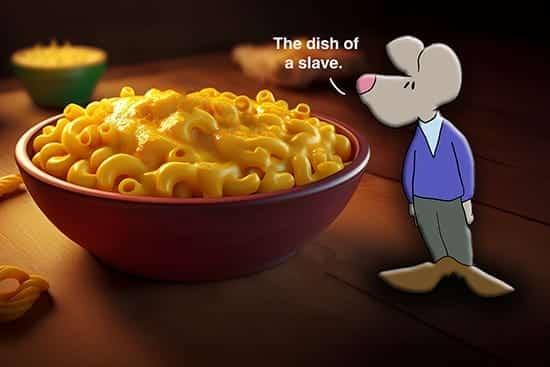
One of my favorite things as a kid was macaroni and cheese. We didn’t ever get the homemade kind. Instead, it was the good old blue box of Kraft Mac & Cheese. I loved it.
But one thing is for sure. All of us have loved some version of that creamy, decadent, delicious macaroni and cheese. We’ve all shared in this goodness — homemade or not.
But here’s the thing most people don’t know. That iconic American dish didn’t begin in some down-home Southern kitchen. Nor did it come from some cozy kitchen in Wisconsin. Nope. It came to the United States through the skill, training, and brilliance of James Hemings, an enslaved chef owned by Thomas Jefferson.
The earliest written version of mac and cheese appears in a 13th-century Italian cookbook. That’s old. But the version we know and love arrived in America by way of France.
Let’s go back to James Hemings. He was born enslaved in 1765 and was part of the large Hemings family tied to Jefferson. When Jefferson married Martha Wayles, James and his siblings (including the famed Sally Hemings) became Jefferson’s property.
Hemings was rare among enslaved people of his time. He could read, write, and showed exceptional talent as a cook. So when Jefferson was appointed Minister to France, he took the 19-year-old Hemings with him. He wasn’t a guest — he was part of Jefferson’s plan. Jefferson arranged for Hemings to train with elite Parisian chefs, learning French culinary arts from the very best.
French chefs were expensive to hire. But enslaved labor, tragically, was not. To save money, Jefferson had professionals teach Hemings and other enslaved cooks everything from pastry work to fine French cuisine.
And there it was — among the dishes Hemings mastered was the French-style macaroni baked with butter and cheese. It was the ancestor of today’s mac and cheese.
Jefferson adored it. He once ordered 80 pounds of Parmesan and boxes of imported macaroni. He had it served at his table often. Hemings was the one who perfected it, serving it in Paris, New York, Philadelphia, and eventually Monticello.
Hemings learned that French law considered him a free man. Despite knowing that, he chose to return to Virginia because his family remained enslaved there. Years later, he negotiated his freedom under the condition that he train a replacement — his brother Peter.
Jefferson freed him in 1796.
Sadly, Hemings died by suicide in 1801. His death wasn’t just a single moment — it was most likely the weight of a complicated life finally collapsing. He had lived in two worlds — enslaved and free — yet truly belonged to neither. After gaining his freedom, he struggled to find steady work, battled isolation, and carried the psychological burden of a life shaped by ownership. He had been trained, praised, and relied upon — yet the world still saw him as less simply because he was Black. In the end, the burden seems to have been too heavy to carry.
But let us remember his legacy — that good mac and cheese. I am thankful for James Hemings. I only wish he could have found peace. I wish he could have found a life as warm and inviting as the dishes he prepared.
“”””””
Food is our common ground, a universal experience. — James Beard
“””””””
History is not the past; it is the stories we tell about the past. — Grace Lee Boggs
“””””””
To cook is to create and to recreate memory. — Edna Lewis
“””””””
Justice will not be served until those who are unaffected are as outraged as those who are. — Benjamin Franklin
“””””””
—