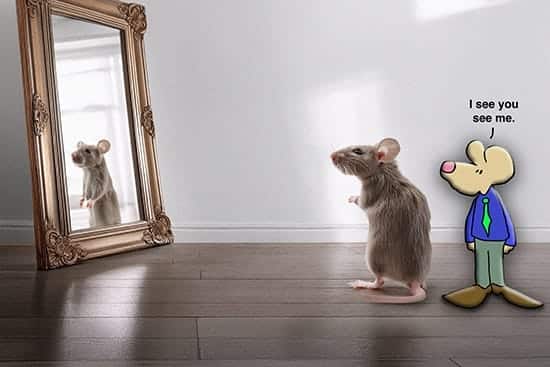
Mirror, mirror, on the wall. Yes. There it is. We’ve all gazed in the mirror and said, “Hey. That is me.”
For years, scientists believed that only humans could recognize themselves in a mirror. Then they learned that a few “big-brained” animals, like chimps, dolphins, and elephants, could recognize themselves too.
But now, look. New research suggests the humble house mouse may deserve a spot on that list. You know I love a mouse.
With that mouse recognition comes a few important caveats. In a study published in Neuron, researchers discovered that mice can show self-recognition-like behavior under very specific conditions. It depends heavily on their social and sensory environments.
The experiment centered around the classic Mirror Self-Recognition Test. This is where an animal is marked with a spot it can’t see without a mirror. I suppose a red “X” on their little foreheads or something. If it uses the mirror to inspect or touch the mark, it’s considered strong evidence of self-recognition.
They did this with mice. A large white spot was placed on their foreheads, which really stood out against their dark fur. Once they saw it, they began grooming themselves intensely. Again, this happened specifically when they were looking in the mirror. It appeared as though they were noticing something “off” about their own image and trying to fix it.
There’s more. Those neuroscientists dug deeper. They identified a group of neurons in the hippocampus that activated not only when mice saw themselves, but also when they viewed other mice that looked like them. This suggested that “self-perception” in mice may be closely linked to social experience.
I’m not sure I quite understand that last part, but the same thing has happened in studies on monkeys and chimpanzees.
So, are mice truly self-aware? It seems they are, but not quite in the human sense. What this study shows is that mice can recognize changes to their appearance under certain conditions.
Still, it opens the door to deeper questions about our animal friends. How does the brain construct a sense of self? And how early in evolution did that ability emerge?
Whatever the answers, I will say it again. We don’t give animals enough credit. They are incredible beings and have a kind of intelligence that we might never fully understand.
“””””””
“The eye sees only what the mind is prepared to comprehend.”— Henri Bergson
“””””””
“We don’t see things as they are, we see them as we are.”— Anaïs Nin
“””””””
“The greatest discovery of my generation is that a human being can alter his life by altering his attitudes.”— William James
“””””””