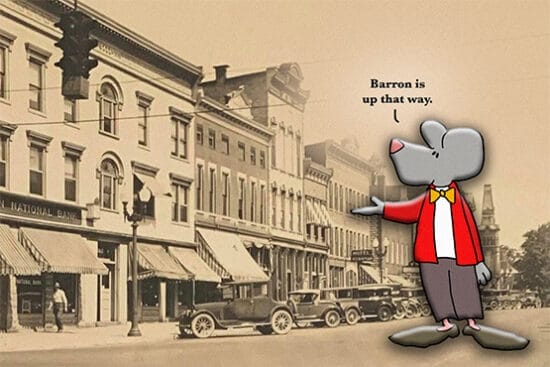
I live in Preble County, Ohio. It is located in the southwestern section of Ohio. We are near the Indiana border. Our county seat is located smack dab in the center of the county. The city name is Eaton, Ohio.
According to the 2020 Census, Preble County, Ohio, has about 40,999 people living here. And Eaton, Ohio, holds about 8,375 people. Give or take a few, I would imagine.
Back to the county seat. As with any city, Eaton has lots of streets with lots of names.
The two “main” drags are Main Street (State Route 35) and Barron Street (State Route 127). I often wondered where Barron Street got its name. As it turns out, it was named in honor of Commodore James Barron, a hero of the First Barbary War.
The street is part of a series of streets in downtown Eaton, which include Decatur, Israel, Wadsworth, and Somers Streets. All of these were named to honor naval heroes and key figures from the First and Second Barbary Wars.
The town itself is named after William Eaton, a U.S. Consul to Tunis (It is the capital city of Tunisia, located in North Africa) during this same period.
He was a bold and unconventional American diplomat. Instead of staying behind a desk, he led a small force of U.S. Marines and local allies across the desert to attack the city of Derna (in modern-day Libya). This became one of the first overseas military actions by the United States and a big reason your town carries his name.
Next, we have James Barron. He was a U.S. naval officer from the same era.
He’s remembered both for service and controversy. In 1807, his ship, the USS Chesapeake, was attacked by the British while unprepared. He was later court-martialed. Years afterward, he fought a duel with fellow officer Stephen Decatur. It was one of the more dramatic episodes in early U.S. naval history.
The duel between Stephen Decatur and James Barron grew out of years of bitterness after Barron was court-martialed for being unprepared during the Chesapeake–Leopard affair. Decatur, a celebrated naval hero, had openly criticized him. When Barron returned to duty, his reputation had been tarnished. So he turned to a formal challenge against Decatur.
In 1820, the two met at a dueling ground in Bladensburg, Maryland, stood just a few paces apart, and fired almost simultaneously. Both men were hit, but Decatur’s wound was fatal. He was carried home, where he later died at just 41 years old. In a final, human moment, the two reportedly reconciled before his death. Tragic.
And the other guys. There was Richard Somers (Somers Street), who is remembered for a high-risk mission during the war that ended in tragedy.
Alexander Scammell Wadsworth (Wadsworth Street) served in the early U.S. Navy during this same period.
Israel Street. This one is a bit less clearly tied to a well-documented Barbary War figure and may reflect a lesser-known or locally interpreted name.
And finally, that First Barbary War. It was fought from 1801 to 1805 along the North African coast of the Mediterranean, primarily around Tripoli (in modern-day Libya). It involved the United States, under Thomas Jefferson, against the Barbary States (especially Tripoli) over demands for tribute and attacks on American shipping.
Those are some of the good names of the streets in Eaton. It looks like the city wanted to honor the heroes of war. But keep in mind, there is a Maple Street, Oak Street, Walnut Street, Cherry Street, Elm Street and Pine Street in Eaton too.
I’ll leaf it to you to decide who they liked more.
“””””””
“History is not a burden on the memory but an illumination of the soul.” — Lord Acton
“””””””
“A nation’s culture resides in the hearts and in the soul of its people.” — Mahatma Gandhi
“””””””
“The streets we walk carry the names of those who came before us, whether we know their stories or not.” — Martin Caine
“””””””


