The World As We See It By Linda Stowe
I was born and raised in Preble County. In my twenties I moved to Dayton and lived there for thirty-four years. When retirement approached, I returned to Preble County by choice — not because there was nowhere else to go, but because I wanted to come home.
During my years in Dayton, my background would occasionally come up in conversation. Words like “country bumpkin” or “backwater” might enter the conversation, sometimes wrapped in humor, sometimes in something that sounded almost like praise. I doubt the speaker meant to suggest I was a foolish, poorly educated yokel raised in stagnation. More likely, they meant to comment on how I had risen above it — as if my beginnings were something sticky I had managed to scrape off my shoes, as if rural life were a kind of cultural slime one ought to outgrow.
When a place holds your history, calling it a backwater can feel like calling you small. I might manage a polite smile, but something in me recoils. Not because I am ashamed of where I’m from, but because I can sense the silent arrangement taking place — an invisible ladder being set up, with someone deciding which rung we each occupy. The judgment isn’t only about geography; it is about worth.
Such comments are stereotypes dressed up as observations, but they take away a person’s uniqueness and slide them into a box already labeled. We all know the labels. Some are loud and headline-worthy. Others are subtle, woven into casual remarks about education, careers, accents, or taste. They say more about our need to measure than about the person being measured.
I have also been guilty of this, on passing judgment. I have looked at someone’s lack of education or life choices and decided something about their ambition or intelligence. I may not come out an say what I am thinking but my private assessment was just as dismissive. I reduced a life to a label. It is easy to believe our measures are neutral — that we are simply observing. But often we are erecting invisible ladders and placing ourselves one rung higher. Perhaps that is what humility is: the moment you recognize the ladder in your own hands.
~~~~~~~
Polly here.
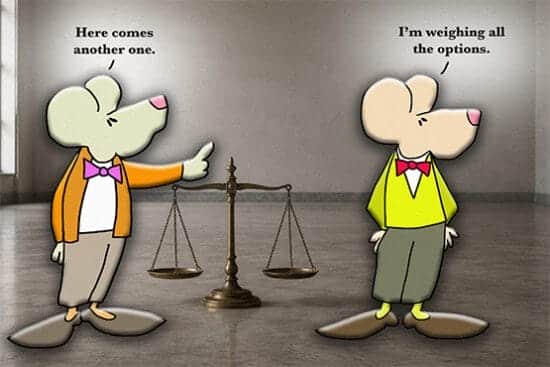
Making judgments. Well… we do. All of us.
Making a judgment is pretty close to making a decision. At the very basic level.
“Do I want pancakes or waffles for breakfast? I think I’ll have waffles. I like waffles more.”
And there it is. A decision and judgment overlapping.
But perhaps they are slightly different.
A decision is simply choosing between options. It’s practical and forward-looking.
A judgment, on the other hand, is an evaluation. It involves forming an opinion about something. And many times it is based on values, beliefs, or interpretation.
Judgments can be a little trickier. We ask ourselves questions about how we think or feel about something. Like these: Is this safe? Is this person trustworthy? Do I belong here?
Our brains are always sorting, labeling, and deciding. But where it gets complicated is what we do with it.
Most of the time, we’re working with incomplete information. We see just a small piece of the pie and not the whole enchilada. It is more of a reaction to something or someone.
That being said, not all judgment is bad. Discernment is important. We need to recognize behavior that’s unkind, unsafe, or wrong.
But judging someone based on their behavior is one thing. Judging someone because of how they look, or where they are from, or what they eat, are entirely different matters.
We should try to find out “who” people are by the way they treat others, or treat the world. If they have a tattoo or are wearing tattered clothes, it probably shouldn’t matter.
And finally, always, we should try to treat others as we want to be treated ourselves.