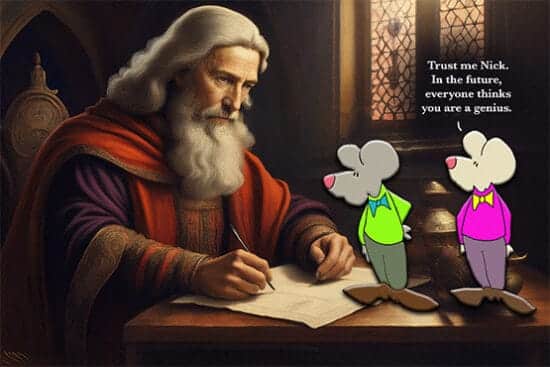
People. People who need people.
As it turns out, to get where we are today, we have needed a lot of people. Not only those in our own lives, but also all the good people from the past.
So many of them. Like Johannes Gutenberg, who figured out the movable-type printing press in 1450. Or how about Mary Anderson, who gave us windshield wipers around 1903. And where would we be without Clarence Birdseye and the accidental birth of frozen foods in 1924?
There are millions of things we depend upon today. And most of the time, we never consider all the people who made these things possible.
And what if your birthday is today? We all get a year older once the Earth takes a lap around the sun. We sort of owe this to Nicolaus Copernicus.
Nicolaus Copernicus was born on February 19, 1473, in the city of Toruń. That’s in north central Poland.
He is mostly known as one of history’s greatest astronomers. But he was also a mathematician, physician, economist, diplomat, translator, and a canon of the cathedral at Frombork Cathedral.
The guy was busy. As such, all these responsibilities left his passion for astronomy as something that he pursued during his spare time.
At the time, nearly everyone accepted that good old ancient idea about the Earth being at the center of things. Everyone thought Earth stood motionless at the center of the Universe. It’s all about me, Earth said.
This Earth-centered model was developed by Claudius Ptolemy more than a thousand years ago. (The P is silent in Ptolemy, in case you need to say his name.)
Anyway. After years of careful observation and mathematical calculations, Copernicus proposed a revolutionary truth. He argued that the Sun, not the Earth, occupied the central position in the planetary system. He told everyone that Earth both rotates on its axis each day and travels around the Sun once each year.
Copernicus spent decades refining his ideas. He finally published his life’s work and called it On the Revolutions of the Heavenly Spheres in 1543. According to history, the first printed copy reached him on the very day he died, May 24, 1543.
Back to his theory. His ideas were not immediately accepted. Many scholars rejected it. To top things off, in 1616, the Catholic Church placed his book on its Index of Forbidden Books until certain passages were altered.
But others thought he was the cat’s meow. His work inspired later scientists such as Johannes Kepler, Galileo Galilei, and Isaac Newton. All of these men’s discoveries transformed our understanding of the Universe.
Here is one more incredible thing. Copernicus never had the luxury of a telescope. He made all of his observations with the naked eye and simple measuring instruments. Amazing.
Big thinkers. Big doers. All the people who have changed our lives in this way? I say thank you again and again.
“”””””””
“If I have seen further, it is by standing on the shoulders of giants.” — Isaac Newton
“”””””””
“Every great advance in science has issued from a new audacity of imagination.” — John Dewey
“”””””””
“We are all apprentices in a craft where no one ever becomes a master.” — Ernest Hemingway
“”””””””
Every ordinary day is built upon the extraordinary work of countless people we’ll never meet. — Christopher Brown
“”””””””