What is this? Sex changes without an operation?
That’s right.
You see, in our grand world, there are many animals that can change their sex.
Apparently, in the animal kingdom, it’s not that unusual to start out as one sex and end up as another. In fact, thousands of species have evolved this amazing capability.
“Oh. Looky there. Yesterday I was a boy frog, and today I am a girl frog. I’m going to have to redecorate my Lily Pad.”
It happens in different ways. Some are genetically programmed to experience a midlife switch. But others might change from one sex to another due to environmental cues.
Here are seven that can do the flip.
1. Slipper Snails
2. Bluehead Wrasses
3. Clownfish
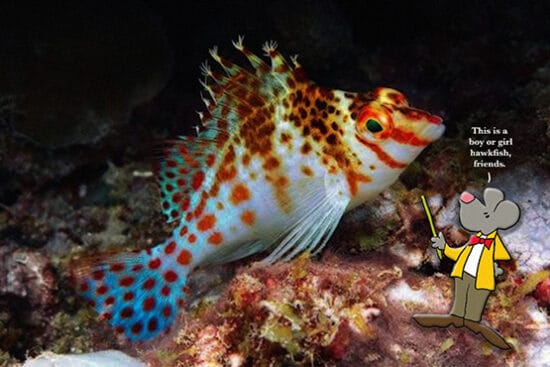
4. Dwarf Hawkfish
5. Green Frogs
6. European Pond Turtles
7. Spiny Softshell Turtles
Here is how it goes for these seven.
Slipper snails begin life as males and later become females. They live stacked on top of one another, with the oldest females at the bottom and younger males on top. Scientists have found that physical contact with other snails helps trigger the change.
Bluehead wrasses, colorful Caribbean fish, all start life as females. When the dominant male disappears, the largest female transforms into a male in about 20 days and takes over the group. But underneath, I bet she is still a woman, running the show.
Clownfish also begin life as males. Each group contains one breeding female and one breeding male. If the female dies, the breeding male changes into a female, and the largest remaining male becomes her new mate.
Dwarf hawkfish are even more remarkable. They can change from female to male when needed and, unlike most sex-changing animals, can switch back again if social conditions change. All willy nilly.
Green frogs can undergo a rare process called sex reversal. It goes like this. A genetically male or female frog develops the characteristics of the opposite sex. Plain and simple. Scientists once believed pollution was the primary cause, but research has shown that this can also occur naturally in wild populations.
European pond turtles can do this early on. The temperature at which eggs develop determines whether hatchlings become male or female. Warmer nest temperatures produce more females, a pattern that scientists believe is being influenced by climate change.
Spiny softshell turtles use a unique combination of genetics and incubation temperature to determine sex. During early development, their embryos temporarily express genes in a way that makes them appear male. Later, genetic signals and nest temperature determine whether they ultimately develop as males or females. Hey baby. What’s your signal?
These remarkable adaptations help species maintain healthy populations and demonstrate the extraordinary diversity of survival strategies found in nature.
I just thought you should know all this. If you are out by your pond and try to kiss the boy frog one day? And then you come back the next day, and it is a girl frog? Don’t worry. It wasn’t your kiss. It was just the way nature made things happen. In a blink.
Nature is powerful and wonderful and mysterious and good.
Take a good look today and see it all for yourself.
“””””””
“Look deep into nature, and then you will understand everything better.” — Albert Einstein
“””””””
“In all things of nature there is something of the marvelous.” — Aristotle
“””””””
“Nature is full of genius, full of the divinity.” — Michel de Montaigne
“””””””
The natural world doesn’t ask our permission to be extraordinary. — Robert Moore
“””””””