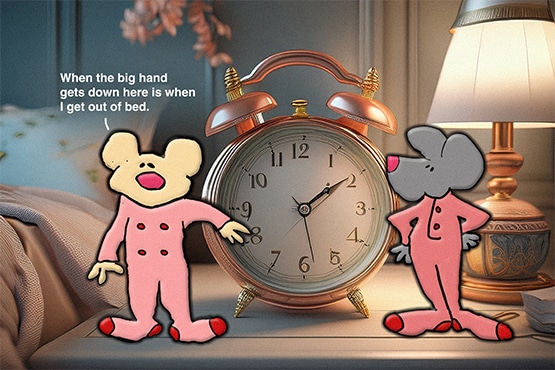
I get up pretty darn early every morning. I do this without an alarm. I just wake up, ready to go most days, between 2:30 am and 3:00 am. The mornings are when I do a lot of my writing.
But tons of people use alarm clocks. They need them. Otherwise, they’d sleep right through and miss the bus.
It made me wonder about how alarm clocks got started.
I found out about that first alarm clock. The one that could reliably wake a person at a preset time. It was invented in 1847 by French clockmaker Antoine Redier.
But it had a glitch.
I should say, unfortunately, it had one major limitation. It could only be set for a single time of day.
So, let’s say it was set for 7:00 am. If you wanted to wake up at a different hour tomorrow, you had to adjust the entire mechanism. The alarm mechanism itself had to be physically repositioned on the clock’s gears whenever you wanted a different wake-up time.
It wasn’t as simple as turning a dedicated alarm hand or pressing buttons like we do today. The adjustment was more cumbersome because the alarm wasn’t an independent, easy-to-use feature. It had to be done by someone who knew how to repair clocks. Or the inventor himself.
Until all of this got ironed out, many people relied on “knocker-uppers.” They were real people who earned a living by walking through towns tapping on bedroom windows with long sticks or shooting dried peas through blowpipes until their customers woke up.
It is funny. I once had this job at a “dormitory” where I had to stay for a month. Everyone had a different job each week. One week, I was the “knocker-upper.”
Now that is alarming.
“””””””
“The morning is wiser than the evening.” — Russian proverb
“””””””
“Lose an hour in the morning, and you will spend all day looking for it.” — Richard Whately
“””””””
“There is a morning inside you waiting to burst open into light.” — Rumi
“””””””
“The future depends on what you do today.” — Mahatma Gandhi
“””””””