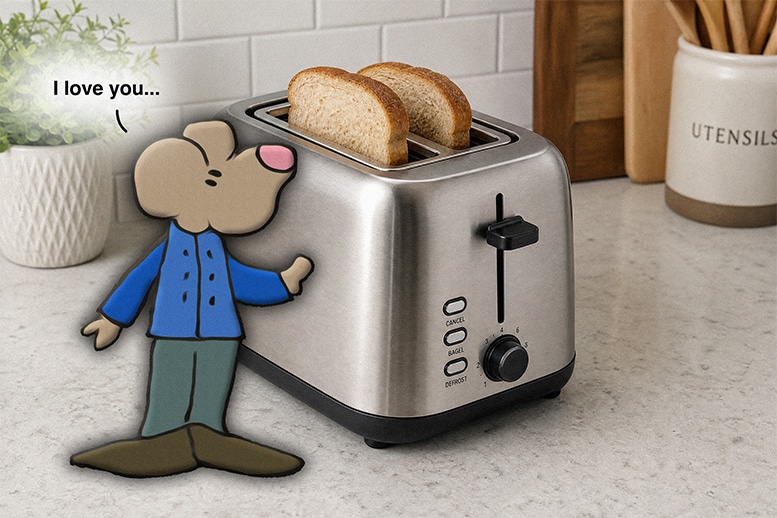
A creature of habit, I am.
Every morning, I eat eggs over easy, ham, and some form of toast. Yes. Glorious bread that I have jammed down into two slots of the magical, incredible, beloved toaster.
Most of us probably don’t give much thought to the toaster sitting on the kitchen counter. That good old trustworthy device. It truly is incredible that we can put in the bread, push down the lever, and a minute or two later, out comes the wonderful entity of toast.
We have one good man to thank for this. His name is Charles P. Strite.
You see, in 1919, Strite was working at a manufacturing plant in Stillwater, Minnesota. The company cafeteria had a problem. Well, they probably had more than one problem. But the one that caught Strite’s attention was burned toast. Apparently, it happened often enough that Strite, a mechanic, decided to do something about it.
Electric toasters already existed, but they didn’t do such a great job. Many toasted only one side of the bread at a time. That meant someone had to watch the bread. They had to turn it over at just the right time and make sure it didn’t burn. Then, when they were sure it was right, they had to eject the bread from the apparatus. Apparently, it was an arduous process. And probably a “volunteer” position, as I couldn’t find any evidence of professional bread watchers back in those days.
Anyway, Strite saw the problem, and he came up with a better idea.
He designed a new toaster. His toaster heated both sides of the bread at once. More importantly, it included a timer that shut off the electricity and a spring mechanism that automatically raised the toast when it was finished.
In other words, the toast popped up.
Yes, the pop-up toaster. Without it, we wouldn’t know toast as we know it today. And we sure wouldn’t have glorious Pop-Tarts.
So. Strite received U.S. Patent No. 1,394,450 for his bread toaster on October 18, 1921. His invention was initially marketed for restaurants, hotels, and other commercial establishments. Then, in 1926, an automatic Toastmaster arrived on the stage. It was designed specifically for home use.
And the timing couldn’t have been much better.
Just two years later, Otto Frederick Rohwedder’s bread-slicing machine went into commercial use. Suddenly Americans could buy loaves containing neat, uniform slices. And wouldn’t you know? Those babies just happened to fit rather nicely into those new and popular toasters.
By 1930, more than a million toasters were being sold each year.
I know why I love this story. And why I love inventions like this.
It is because there is always someone like Charles Strite. He was probably mildly annoyed with an everyday problem and figured out a way to do something about it.
He didn’t invent toast. He didn’t invent electricity. He didn’t even invent the first toaster.
He just thought that burned bread really sucked. And that there had to be a better way.
So yes. Here we have it. On every kitchen counter far and wide, almost.
And a wonderful part of my every morning.
Thanks for the pop-up, Charles.
Next: To butter or not to butter. That is the question.
“”””””””
“The value of an idea lies in the using of it.” — Thomas Edison
“”””””””
“Simplicity is the ultimate sophistication.” — Leonardo da Vinci
“”””””””
“Great things are done by a series of small things brought together.” — Vincent van Gogh
“”””””””