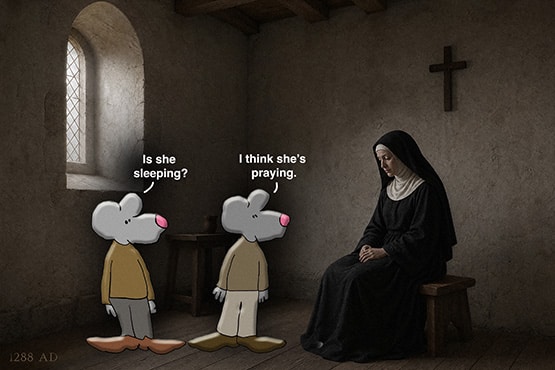
I often imagine what it must have been like to live in certain times in history. I speculate. Of course, we can never really know entirely. But.
Imagine being born in the year 1098.
No electricity. No printing press. Bathrooms? Holy Heck. No modern medicine. No modern anything.
Most books had to be copied by hand. And. More than anything: Opportunities for women to become scholars were practically nonexistent.
And then along came Hildegard von Bingen. First of all, I love her name. The whole thing.
Anyway. Hildegard was a German Benedictine nun who somehow managed to become a composer, writer, philosopher, theologian, poet, naturalist, medical writer, and eventually an abbess. She founded two monasteries and lived to the impressive age of 81. For back then, that was ancient to be 81. And all of this was truly amazing for 1098 to 1179 or thereabouts.
But perhaps the most fascinating thing about Hildegard was that she experienced mysterious visions beginning when she was very young. She described seeing a brilliant light and believed the visions came from God. Eventually, she began recording what she saw and experienced.
And she wrote. A lot.
Hildegard wrote about everything under the sun, it seems. She wrote about theology, plants, animals, medicine, the human body, and the natural world. She also composed dozens of musical works. More of her chants survive today than those of any other known medieval composer.
She even wrote Ordo Virtutum, or Play of the Virtues. This was a musical drama depicting the struggle between the human soul, the virtues, and the Devil. The old “good vs. evil” number, I suppose. Written in the 12th century, it is considered one of the earliest surviving morality plays.
Anyway, I find her remarkable. Just the sheer range of her curiosity is something else.
And she wrote all the time, about everything. The amazing part is that people paid attention to what she said.
This medieval nun corresponded with popes, emperors, bishops, and other powerful people. She even traveled and preached publicly, something highly unusual for a woman of her time.
Her life was incredible for that time in history.
Hildegard died on September 17, 1179.
More than eight centuries later, in 2012, Pope Benedict XVI officially declared her a Doctor of the Church, a rare title recognizing individuals whose teachings have made an important contribution to Christian theology.
Nearly 900 years after her birth, we’re still reading her words and listening to her music. But to be completely transparent, I don’t have her on my Spotify.
“””””””””””
“There is the music of Heaven in all things.” — Hildegard von Bingen
“””””””””””
“The soul is the breath of living spirit.” — Hildegard von Bingen
“””””””””””
“The earth which sustains humanity must not be injured.” — Hildegard von Bingen
“””””””””””
“Every creature is a glittering, glistening mirror of divinity.” — Hildegard von Bingen
“””””””””””
“The soul is not in the body; the body is in the soul.” — Hildegard von Bingen
“””””””””””