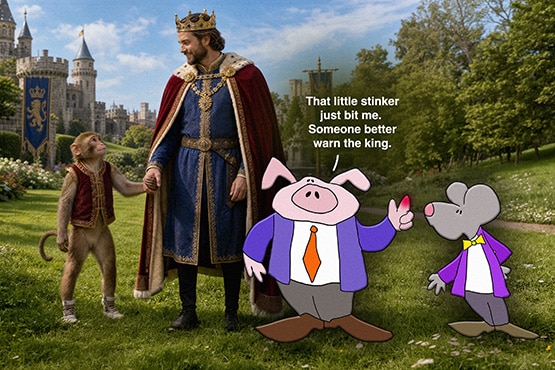
First of all, before even getting into this piece, I’d like to point out that I’ve never been to Greece, never been a King or a Royal, and at the present day, I do not know any monkeys.
Even still. All three of these things come together in the ensuing story in a way that interests me.
We all know that history is filled with great battles, political upheavals, assassinations, revolutions, and all sorts of things along these lines.
But every now and then, our good old history has been changed because of something just a little bit weird.
Like a monkey.
So here is the story of how it went.
Alexander became King of Greece in 1917 when he was only 23 years old. He wasn’t actually supposed to be king. His father was King Constantine I. Constantine was forced from the throne during World War I because of his pro-German sympathies. Alexander’s older brother was also considered unacceptable by the Allied powers. So, dear young Alexander suddenly found himself wearing the crown. Again, only 23 years of age.
But he didn’t have much real power. Greece’s prime minister was Eleftherios Venizelos at the time. Venizelos largely controlled the entire government. And that left Alexander serving as king in a milk-toast sort of way during an incredibly complicated period in Greek history.
His personal life wasn’t much easier.
Alexander fell in love with Aspasia Manos, the daughter of a Greek colonel. The problem was that she wasn’t royalty. Their marriage caused quite a scandal, and the couple briefly left Greece amid the controversy.
And then what happened next is just plain strange.
On October 2, 1920, Alexander was walking on the grounds of the royal estate at Tatoi with his dog, Fritz. (My first cat was named Fritz, by the way.) Anyway. The dog became involved in a fight with one of two Barbary macaques kept on the estate. (A Barbary macaque is a type of monkey native to North Africa, particularly Morocco and Algeria. Apparently, they were part of the Royal Estate, like pets, sort of.) When Alexander tried to separate them, the second monkey attacked him and bit him severely.
He was bitten on the leg and torso.
At first, the wounds didn’t seem particularly serious. But this was 1920, long before antibiotics were available. The bites became infected. Alexander developed sepsis, and despite attempts to save him, his condition steadily worsened.
He died on October 25, 1920. He was only 27 years old.
And there is also this. The two monkeys were later killed, but by then the seemingly minor incident had already set in motion a terrible tragedy.
Anyway, here is the part that is incredible. His death helped change the political direction of Greece. Elections followed his death. Venizelos lost power, and Alexander’s father, Constantine, eventually returned to the throne.
Alexander’s wife was pregnant when he died. Their daughter, Alexandra, was born five months later and would eventually become Queen of Yugoslavia.
All of this resulted in Greece’s direction. All because one afternoon, a king tried to break up a fight involving his dog and a monkey.
History certainly has some strange ways. Monkey bites and all.
“””””””
“Life is what happens to you while you’re busy making other plans.” — John Lennon
“””””””
“History is the sum total of things that could have been avoided.” — Konrad Adenauer (commonly attributed)
“””””””
“The unexpected is always upon us.” — John F. Kennedy
“””””””
“Men make their own history, but they do not make it as they please.” — Karl Marx
“””””””