I have a sister in Montana. She lives in the capital city of Helena. I’ve been to visit. Once. It is a big state, I’ll tell you.
But I just found out something I never knew about that place.
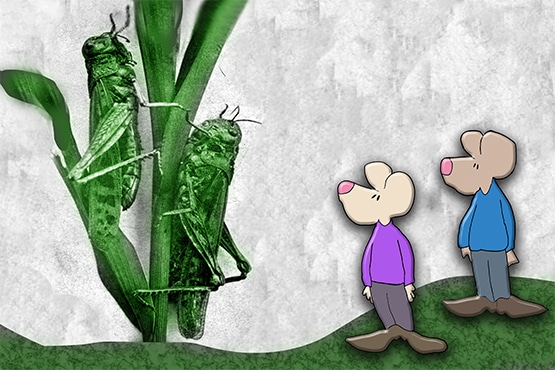
There is a glacier in Montana filled with dead grasshoppers. Millions of them. And, apparently, some have been trapped in the ice for hundreds of years.
Here is another thing. It’s appropriately named Grasshopper Glacier.
It is located high in Montana’s Beartooth Mountains. That’s roughly 11,000 feet above sea level. And the only other thing I can tell you is that this glacier holds the remains of enormous swarms of grasshoppers that met an unfortunate end.
So. How did this big grasshopper ice cube happen?
Scientists believe that the insects were migrating across the Rocky Mountains when they ran into severe snowstorms. Unable to survive the freezing temperatures, they fell onto the snow and were eventually buried beneath layers of ice.
That was the end of those grasshoppers. And there they remained.
In 1898, geologist James P. Kimball explored the area and reported astonishing quantities of grasshopper remains. He estimated that thousands of tons of insects were preserved near the glacier’s lower edge.
Thousands. Of. Tons. Of. Grasshoppers.
But here’s where the story gets even more interesting, I think. In an insect-y sort of way.
Some of these insects belonged to a species called the Rocky Mountain locust, which is now extinct.
So what? Well. During the 1800s, these locusts were an absolute nightmare for American farmers. They traveled in enormous swarms, devouring crops and vegetation.
In 1875, one particularly huge and scary swarm was estimated to contain 12.5 trillion insects and cover approximately 198,000 square miles. To put that in perspective for you, that’s larger than the entire state of California.
But. At some point, they just disappeared from existence. Completely. No other indicators. They just disappeared.
By the early 1900s, the Rocky Mountain locust had become extinct. Scientists still debate exactly why, although destruction of its breeding habitat through agriculture is a leading explanation.
Today, Grasshopper Glacier is disappearing too. Thanks to us dumb humans and global warming.
Rising temperatures and shrinking ice have exposed many of the insects. Once they emerge from their frozen graves, they quickly deteriorate.
So. A little nature story for you. Nature is incredible. And sometimes it has a way of preserving history in the most unexpected places.
Like in glaciers filled with grasshoppers.
“””””””
“Nature is not a place to visit. It is home.” — Gary Snyder
“””””””
“In all things of nature there is something of the marvelous.” — Aristotle
“””””””
“The poetry of the earth is never dead.” — John Keats
“””””””