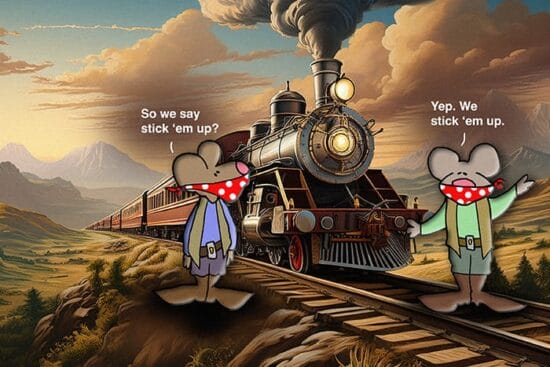
There has to be a first time for everything.
So, what about train robberies? Well, the first one, here in the United States, happened on October 6, 1866. There were two brothers. John and Simeon Reno. They staged the first train robbery in American history, making off with $13,000 from an Ohio and Mississippi railroad train. This happened about 100 miles from my home. In Jackson County, Indiana.
Of course, trains had been robbed before the Reno brothers’ holdup. But these previous crimes had all been burglaries. People would break into stationary trains sitting in depots and such.
The Reno brothers made criminal history because they were the first to stop a moving train. They planned and planned, probably. They robbed the train in a sparsely populated region where they could carry out their crime without risking interference from the law. Or even curious bystanders.
The Reno brothers’ new method of robbing trains quickly became very popular in the West, even though the first one occurred in Indiana. Many of those old-time bandits were mostly busy with robbing banks or stagecoaches. But they soon discovered that the newly constructed railroads in the West made really great targets.
You see, with the Western economy booming, trains often carried large amounts of cash and precious minerals. The wide-open spaces of the West also provided train robbers with plenty of isolated areas ideal for stopping trains. It was a double bonus out there in the middle of nowhere, because there were plenty of wild spaces where those robbers could hide from the law.
Some criminal gangs, like Butch Cassidy’s Wild Bunch, found that robbing trains was so easy and lucrative that for a time they made it their criminal specialty.
But the railroad owners were not having any of it. They were not about to sit back and let Cassidy or any other bandit freely ransack their trains.
So those owners started putting the cash and precious metals on trains in well-protected, massive safes. These safes were watched over by heavily armed guards.
Some railroads, such as the Union Pacific, even began adding special boxcars designed to carry guards and their horses. In the event of an attempted robbery, these men could not only protect the train’s valuables but could also quickly mount their horses and chase down the fleeing bandits.
Much to the dismay of those masked bandits, by the late 19th century, train robbery became increasingly difficult and dangerous.
So it fell to the wayside. Stick ’em up, no more.
“””””””
“Robbery is a reflection of desperation, not ambition.” — Robert Rice
“””””””
“The outlaw is a product of the frontier. He is not a criminal by nature but a victim of circumstances.” — Billy the Kid (as attributed)
“””””””
“The outlaw had his own code — it wasn’t the law’s code, but it was a code just the same.” — Louis L’Amour
“””””””