AI By Linda Stowe
(Editor’s Note: This was written several months ago as part of our Wordle Words)
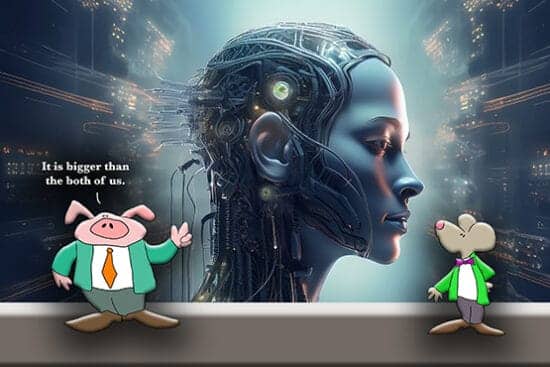
This morning, I listened to a New York Times podcast about the likelihood of AI taking over people’s jobs. Discussions about the impact of AI on the job market are in vogue right now, probably because of all the uncertainty. People who imagine themselves on the career path to becoming a business mogul may one day find that path rerouted into something far more ordinary.
As I listened, I found myself thinking that AI would never be able to replace parents. And then one of the podcasters mentioned that he uses AI to help pack his son’s daily lunch. He simply holds his phone up to the open refrigerator; the app scans what is available and, drawing on its stored knowledge of the boy’s preferences, suggests two or three possible combinations.
I have used ChatGPT to help with menu planning, but to do so, I first prepared a long, detailed list of everything in my pantry and freezer. It took me two hours. The idea of simply showing the contents to ChatGPT did not occur to me.
That realization suggests two things. First, AI may be able to achieve results similar to a human’s, though not necessarily by following the same process. Second, the limits of AI may have less to do with its capacity than with our imagination. Of course, we still do not know what ideas might occur to AI on its own.
Wordle guess words: about, occur, vogue, mogul
~~~~~~~
Polly here.
This is all so amazing to me. I recently watched a news segment on the same topic. While it probably wasn’t as long or as detailed as your podcast, the man being interviewed suggested that jobs will be replaced, but an equal or greater number of jobs will be created as a result.
He likened the resistance to AI as the same reaction to electricity when it was first introduced to the public. Or cars. Or any other groundbreaking technology in history.
Each innovation displaced some work while creating entirely new kinds of opportunities people could not have imagined beforehand.
That does not mean the fears surrounding AI are unfounded. Change rarely arrives without disruption. Some jobs may shrink or disappear altogether. Tasks that once required hours of human effort can now sometimes be completed in minutes. And that raises difficult questions about education, careers, and what skills future generations should develop.
Still, history suggests that humans tend to adapt. New technologies often create demand for other new roles. These new “parts” of the equation might be centered on oversight, creativity, ethics, maintenance, and entirely new industries.
A hundred years ago, few people would have predicted software engineers, social media managers, or cybersecurity analysts.
Maybe the bigger question is not whether AI will replace people, but which distinctly human qualities become more valuable because of AI. Curiosity. Judgment. Empathy. Wisdom. Original thinking. The ability to recognize meaning instead of merely processing information.
And perhaps imagination, too.