Cooking advice. We all have gotten cooking advice in our lives. And chances are, we’ve handed out some of that same advice. It seems to get passed down through families and friends.
But how much of the cooking advice and tidbits are actually just crazy legends?
You know how it starts. Somebody’s grandmother swore by it. And then a television chef repeated it. And eventually it became an accepted kitchen “truth.”
The problem with this whole scenario is that some of the most common cooking rules are not actually true at all. As such, a lot of long-standing food myths have been challenged in recent years. People like chefs, food historians, and kitchen science experts have questioned the validity of these. And in many cases, they turn out to be myths.
Here are six common cooking misconceptions that many people still believe.
1. The red liquid in meat is blood.
Despite appearances, the reddish juices in steak are mostly water mixed with a protein called myoglobin. This is what helps carry oxygen through muscle tissue. Most of a cow’s blood is removed during processing, so your “bloody” steak is not actually full of blood.
2. Searing meat locks in juices.
Searing creates a flavorful crust. A crunchy bunch. But it does not seal moisture inside the meat. In fact, some studies show seared meat can actually lose more liquid. What searing really adds is texture and color.
Also, it brings about the rich flavor created by the Maillard Reaction. For those who don’t know, the Maillard reaction (pronounced my-YARD) is a chemical reaction. It occurs between amino acids (from proteins) and reducing sugars. It happens when food is heated. It is what creates the brown color, rich flavor, and aroma in many cooked foods.
3. You should never wash cast iron with soap.
This used to be good advice decades ago when soaps were much harsher. Modern dish soap is gentler and will not destroy a well-seasoned cast-iron skillet. The key is drying the pan thoroughly and lightly oiling it afterward.
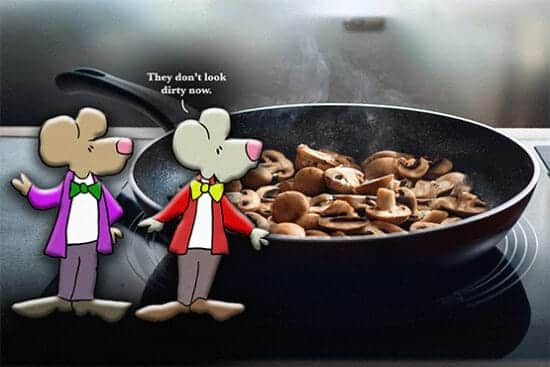
4. Mushrooms should not be washed.
Many people worry that mushrooms absorb too much water, but a quick rinse is perfectly fine. Food experts say washing mushrooms briefly will not ruin their texture or flavor. Just avoid soaking them and cook them soon after rinsing.
5. Microwaves destroy nutrients.
Microwaving food is not inherently worse than other cooking methods. In some cases, it may actually preserve nutrients better because the cooking time is shorter. Vegetables cooked in water can lose nutrients as they boil, while microwaving often retains more of them.
6. Olive oil should go into the pasta water.
Adding oil to pasta water does little to stop sticking, but it can make the sauce slide off the noodles later. Stirring the pasta while it cooks works much better. Olive oil is best added at the very, very end, not the beginning.
Food myths tend to stick around because they sound logical. Or, they hang around because generations repeat them without question.
Cooking is a good, good thing. It is part tradition and part science. But, as we have seen here, some of those kitchen wisdoms we grew up hearing turn out to be more fiction than fact.
And the moral of this story? If you spill salt in the kitchen, you better toss some over your left shoulder.
“””””””””
“Cooking is like love. It should be entered into with abandon or not at all.” — Harriet Van Horne
“””””””””
“No one is born a great cook, one learns by doing.” — Julia Child
“””””””””
“The only real stumbling block is fear of failure. In cooking, you’ve got to have a what-the-hell attitude.” — Julia Child
“””””””””
“Science can make life easier. But wisdom can make it richer.” — John C. Maxwell
“””””””””