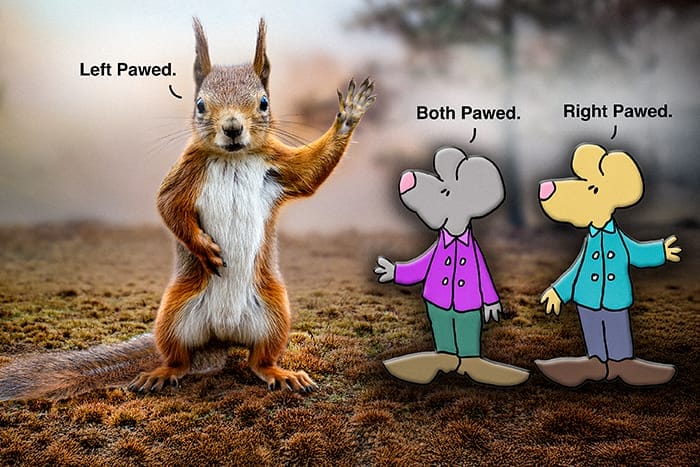
I’m right-handed. I know a few lefties, but they are, indeed, fewer. About 10% of the world’s population is left-handed. About the same percentage of people are gay. But these two things are not one and the same.
Anyway. I happened to think about animals. Could they be favorite-handed?
I found out that some of them are either right-handed or left-handed.
A study at the University of Exeter (that’s in England) found that many squirrels strongly favored one paw over the other. Either or.
By the way. This one-sidedness is known as lateralization.
Okay. So. Like humans, other animals often favor one side of their body for certain tasks. Here is a good for instance. If we ask our dogs to shake hands, they always offer their left or right paw. This lateralization thing again.
Apparently, studies suggest that lateralization makes the brain more efficient because each brain hemisphere focuses on particular tasks.
So the researchers at Exeter started looking for whether there was a correlation between strong lateralization and performance. They used the gray squirrels on campus for their study. I wish I could have watched this!
They did all sorts of testy tests. But they saw that strongly lateralized squirrels were not quite as good at learning. The ones who were ambidextrous were better when it came to learning new activities. Innovative nut burying, I suppose.
But “handedness” is common in most animals.
Primates (e.g., chimpanzees, gorillas):
Many primates show a preference for one hand, especially in tasks involving tools. Or when the complete complex movement. Here’s another thing. Chimpanzees often favor their right hand just like we humans.
Dogs and Cats:
Both species can be left-pawed or right-pawed. It varies individually. But this is a fun little bit. Many studies suggest male dogs are more often left-pawed, while females tend to be right-pawed. High five me on that one.
Birds:
Parrots and some other birds will show a foot preference for grabbing food or toys. The favorite talon.
Fish:
Some fish will turn more often to one side when evading predators or navigating. Just watch Dory swim in Finding Nemo.
And finally.
Elephants:
They can be “trunk-handed” it seems. They use one side of the trunk more often to pick things up. Like pesky humans.
Why do I care? Well. I love to learn about the animal kingdom, for one thing. And then there is this. Lateralization helps with brain efficiency. Across all species. Even in humans.
Specializing certain tasks to one side of the brain or body allows animals to react faster and process information more effectively. Just like in humans, this can influence everything from survival tactics to social behavior.
So I guess being either right or left-handed has advantages and disadvantages.
I think the next time I see an animal, no matter who it might be, I will wave to them. I’ll make a note of what paw they use to wave back. To conduct my study, I’ll wave to them again and again. And then I’ll see.
“””””””
“Handedness is not just a curiosity—it’s a window into the architecture of the brain.”
— I.C. McManus
“””””””
“Animals are born who they are, accept it, and that is that. They live with greater peace than people do.”
— Gregory Maguire
“””””””
“Nature doesn’t draw lines as cleanly as we do—she’s full of surprises and exceptions.”
— Temple Grandin
“””””””
“Not everything about us is a choice—sometimes it’s just how we’re wired.”
— Susan Cain
“””””””


