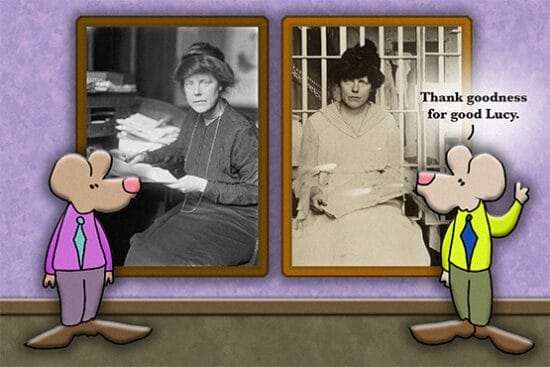
I like to learn about people from the past. Especially, those strong people who fought for their beliefs. Those people who did the right thing. The people who made a difference.
One such individual was Lucy Burns. I had seen her name in passing a few times. But I never looked into who she was. Until now.
She was born in Brooklyn in 1879. And as a young person, Burns was pretty brilliant. She studied linguistics at Vassar (Vassar College is a private liberal arts college located in Poughkeepsie, New York), then continued graduate work at Yale and Oxford. She took on an academic path that few women of her era were even allowed to imagine.
But it was in England where her life shifted toward making a mark in history.
While she was abroad, Burns encountered the British suffragist movement. She was completely enthralled by the women who were fighting for freedoms and rights. The whole deal grabbed her completely. She started the good work on her own.
Burns didn’t just support the cause of women’s voting rights. She gave herself to it fully. She worked hard for the movement in Britain. As such, she endured repeated arrests. She went on hunger strikes while imprisoned. She was completely committed in every way. Burns was relentless.
When she returned to the United States, she brought that same enthusiasm with her. She soon joined forces with Alice Paul. Together, they shifted the tone of the American suffrage movement.
They pushed. They did not want merely a gradual change. Instead, they worked for a constitutional amendment guaranteeing women the right to vote. Burns helped form the Congressional Union for Women’s Suffrage, which later became the National Woman’s Party in 1916.
One of the movement’s most defining moments came on March 3, 1913, when Burns and Paul organized the massive Women’s Suffrage Procession through Washington, D.C. The march was led by Inez Milholland, riding on horseback in white. At the time, it was extremely controversial.
Women were sent to the Occoquan Workhouse in Virginia. They were confined in filthy, freezing conditions and forced to perform hard labor. Some were beaten during what became known as the “Night of Terror” in 1917.
Many of these women were jailed repeatedly. When imprisoned, the suffragists went on hunger strikes to protest their treatment. Officials responded brutally. They often had tubes forced down their throats or noses, and liquid food was poured into their stomachs. It was painful and dangerous. Some women suffered long-term health effects.
All the hard work and suffering and turmoil that these women endured finally paid off.
Then, in August of 1920, the fight finally paid off. The Nineteenth Amendment was ratified, granting women the right to vote.
And Lucy Burns did something highly unexpected.
She walked away from it all.
She did not stay there in the spotlight. She did not expect any accolades.
She just returned to Brooklyn and lived the rest of her life without any hoopla. Just a normal life.
It was as if the work was done, and it didn’t need her anymore. Or maybe she was just tired. Who knows.
Burns died in 1966 at the age of 87.
I will always remember the amendment. It is because of Lucy Burns and the women like her that I have been afforded such a privilege. But people often forget the women who starved, suffered, and endured imprisonment to make it happen.
I am so grateful to and for Lucy Burns.
“”””””””
“There will never be a new world order until women are a part of it.”
— Alice Paul
“”””””””
“When a subject is resisted fiercely, it is usually because it matters profoundly.”
— John Stuart Mill
“”””””””
“I am no longer accepting the things I cannot change. I am changing the things I cannot accept.”
— Angela Davis
“”””””””
“History has shown us that courage can be quiet, and sacrifice doesn’t always ask to be remembered.”
— Howard Zinn
“”””””””