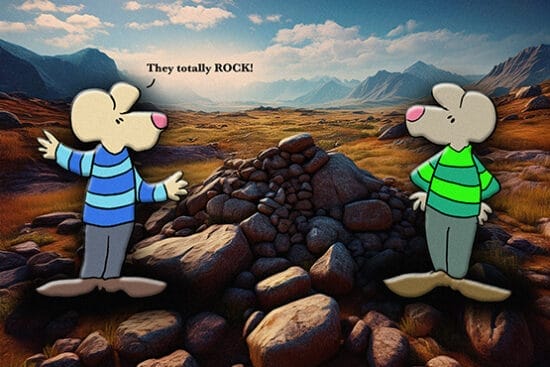
Earth is built of something. Lots of things. We tend to think of the Earth as solid.
It is our big, stable, durable, big old ball that we all stand on. Both feet firmly planted.
But beneath our feet is a restless archive.
Every rock we step on has its own little story. Could it be that every grain of sand is part of a former mountain?
Whew. All of those minerals in our planet. They make this place. They hold the planet together.
A mineral, by definition, is pretty simple. A thing that is naturally occurring. Inorganic. Solid.
Each mineral has a precise chemical makeup and a crystalline structure. That structure repeats itself over and over, atom by atom.
They are not rocks. Minerals and rocks often get lumped together, but they’re not the same thing. Minerals are the basic building blocks. As I mentioned, they are naturally occurring solids with a specific chemical makeup and an orderly crystal structure. Quartz is always quartz; salt is always salt.
Rocks, on the other hand, are combinations of one or more minerals fused together by time, pressure, heat, or sediment. Granite, for example, is a rock made of several different minerals. Think of minerals as letters and rocks as words. The letters stay the same, but the words change depending on how they’re arranged. And now we know.
There are thousands of kinds of minerals, and even more rocks.
More than 5,000 minerals have already been identified, and scientists suspect the true number may be closer to 10,000.
Some minerals are made deep in the Earth under crushing pressure. Others form very slowly at the surface through evaporation or oxidation. Our planet. Always churning and shifting.
Yet despite this staggering diversity and number of minerals, most of the Earth’s crust is made from just a few. Quartz. Feldspar. Calcite. Mica. Halite.
Quartz hardens our sand. Feldspar shapes our soil. Calcite builds caves and cliffs. Halite preserves our food and records ancient seas. Mica is famous for splitting into thin, flexible sheets. It is found in a ton of things.
And then there are the silicates. Silicate minerals make up more than 90 percent of the Earth’s crust. Here’s another thing. If we’re holding a typical rock, chances are we’re holding silicates stacked, fused, and layered by geology and time.
The cool thing? Minerals are also timekeepers.
They record pressure, heat, water, and chemistry. They tell geologists where oceans once existed. They let us know where volcanoes erupted and where continents collided. Long before we were here to notice, minerals were already paying attention to everything about the Earth.
If you ask me, there is something very cool about that. When we pick up rocks, we can feel this history, if we choose to.
There is energy in these minerals and these rocks.
That structure matters.
Their patience throughout history might help us with our patience.
They have been with us always. Before us. And long after us.
“”””””””
“The Earth has music for those who listen.”
— William Shakespeare
“”””””””
“The history of the Earth is written in its rocks.”
— Charles Lyell
“”””””””
“Nature does nothing uselessly.”
— Aristotle
“”””””””
“Geology is the science of the Earth’s memory.”
— Marcia Bjornerud
“”””””””


