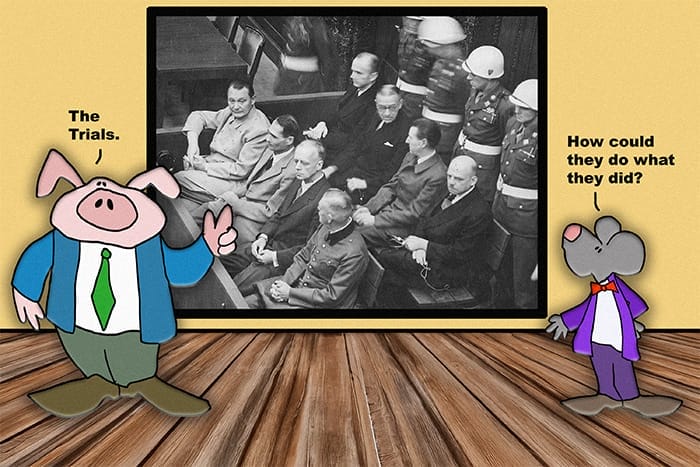
Lately, I have been thinking about the Nuremberg Trials. I see a lot of this same unthinkable hatred building in the United States right now. I’ve also seen and heard those same ideologies taking shape here in our country.
But stepping back in history, many people aren’t especially familiar with these trials. It was quite a thing. And on November 20, 1945, the world held its breath as the Nuremberg Trials began. This all took place in a courtroom in Nuremberg, Germany. Twenty-four high-ranking Nazi officials faced justice for atrocities committed during World War II.
For the first time in history, leaders of a nation were held personally accountable for crimes committed under their command. The tribunal was made up of judges from the United States, the Soviet Union, France, and Great Britain. These four nations came together to declare that “just following orders” was no longer a valid excuse.
Over ten months and 216 court sessions, the proceedings revealed shocking details of the Holocaust. The trials also uncovered the brutal workings of Nazi policy.
The charges included “crimes against peace (starting an aggressive war), war crimes (violating the laws of war—such as the killing of prisoners and civilians), and crimes against humanity (acts like genocide, enslavement, and persecution of entire groups).”
We are most familiar with the term war crime, and have a tendency to group everything under its umbrella. But, a war crime by definition is an act that violates the accepted rules of warfare. This includes things like the deliberate targeting of civilians, mistreating prisoners of war, or using torture and chemical weapons. The concept is rooted in the belief that even in war, there are moral and legal boundaries that must not be crossed.
Anyway, by the end of the trials, twelve of the defendants were sentenced to death, seven received prison terms, and three were acquitted.
Hermann Goering, Hitler’s second-in-command, took his own life the night before his scheduled hanging. Ten others were executed by hanging on October 16, 1946.
Hermann Göring — Head of the Luftwaffe (German Air Force) and Hitler’s designated successor; committed suicide by cyanide the night before his scheduled hanging.
Joachim von Ribbentrop — Nazi Foreign Minister.
Wilhelm Keitel — Field Marshal and Chief of the Armed Forces High Command.
Ernst Kaltenbrunner — Senior SS officer involved in concentration camp operations.
Alfred Rosenberg — Chief Nazi ideologue and author of The Myth of the Twentieth Century.
Hans Frank — Governor-General of Nazi-occupied Poland, known as the “Butcher of Poland.”
Wilhelm Frick — Minister of the Interior; signed laws establishing the Nuremberg racial laws.
Julius Streicher — Publisher of the anti-Semitic newspaper Der Stürmer.
Fritz Sauckel — Head of forced labor recruitment.
Alfred Jodl — Chief of the Operations Staff of the Armed Forces High Command.
Arthur Seyss-Inquart — Austrian Nazi leader, Reich Commissioner for the Netherlands.
Martin Bormann — Hitler’s private secretary; sentenced to death in absentia, later confirmed dead.
The Nuremberg Trials didn’t erase the horrors of the Holocaust, but they set an essential precedent. They demanded that no leader, soldier, or government stand above the law. The trials became the foundation for modern international justice. Those trials paved the way for later courts that would try war crimes in places like Rwanda, Yugoslavia, and beyond.
May we never forget that justice, though delayed, still matters.
“”””””””””
“Justice cannot be for one side alone, but must be for both.” — Eleanor Roosevelt
“”””””””””
“The Nuremberg trials represent humanity’s desperate attempt to reassert the rule of law after the chaos of war.” — Telford Taylor
“”””””””””
“Law is not law if it violates the principles of eternal justice.” — Lydia Maria Child
“”””””””””
“The opposite of love is not hate, it’s indifference.” — Elie Wiesel
“”””””””””


