0913
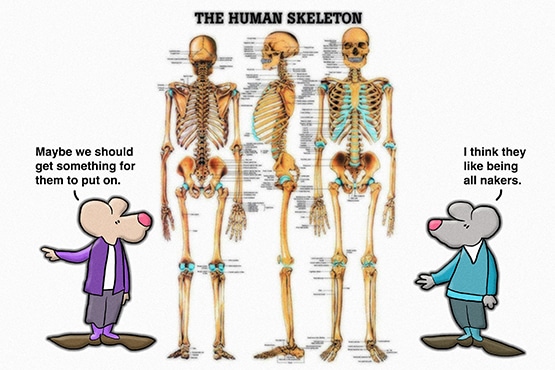
There are no bones about it.
It means there is no doubt about it. It is absolutely true. We can speak plainly and directly, without hesitation or apology.
That good phrase dates back to 15th-century England. That makes it more than 550 years old. Surprisingly, it has nothing to do with skeletons. It likely comes from finding bones in food, especially soup or stew. In medieval times, discovering a bone in your meal made eating unpleasant and difficult.
If you “found bones” in something, you found an obstacle or objection.
If you “found no bones,” there was nothing to hinder you. No blocks. You could swallow it easily and proceed without complaint. Over time, this evolved into “make no bones about it,” meaning to have no hesitation, no objections, and no uncertainty when saying or doing something.
I said this phrase the other day, and it made me wonder how it got started. Of course, once I get to wondering, I start to wander.
Like. I found out that babies are born with almost 100 more bones than adults. You’d think there would be fewer, given their tiny bodies. But no. They have more.
The human body has 206 bones as adults. But babies have closer to 300. What happens to those extra bones? As children grow, many of these separate bones gradually fuse together.
I wonder if it hurts and makes them cry. But. Here is a thing. Newborns certainly cry. And they make plenty of noise doing it. But they generally don’t produce visible tears.
You see, their tear glands are present at birth but aren’t fully developed. Most babies don’t begin producing enough tears to roll down their cheeks until they are somewhere between 2 weeks and 2 months of age. Sometimes longer.
Back to the bones.
Do you know what the smallest bone is in the human body?
It is something called the stapes (pronounced STAY-peez) is the smallest bone in the human body.
It is located in the middle ear and is only about 3 millimeters (0.12 inches) long. That is about the size of a grain of rice.
One more fun bone fact.
Although adults have 206 bones, more than half of them are in the hands and feet.
Hands: 27 bones each (54 total)
Feet: 26 bones each (52 total)
That means 106 of your 206 bones are located in your hands and feet. That’s just over half, of course. I’m waving to you right now. One-handed. That’s 27 bones clacking around your way.
Here’s one more good one to think about.
Humans and giraffes have the same number of neck bones.
It is true. Giraffes have the longest necks in the animal kingdom. There’s no big surprise there. They can reach a length of 8 feet, twice as long as the neck of any other creature. But those good giraffes have the same number of cervical vertebrae as humans. And that number is seven.
As you may have guessed, the key difference is size. The giraffes’ vertebrae are much longer, with each of them measuring close to 10 inches in length. In us shorter humans, the entire vertebral column is around 28 inches for men and 24 inches for women. So we are less than three of a giraffe’s single vertebrae.
Apparently, we have the same number of neck bones as our tall, spotted friends for the simple reason that we’re both mammals. All mammals have seven. The outcasts in this? Sloths and manatees are the only members of this particular class that don’t have seven. (Manatees, six. Sloths, eight or nine.)
I understand that manatees probably need less. But I wonder why sloths have to have two extra? Maybe it is their crazy dance moves.
“””””””””
“Nature is endlessly inventive.” — Carl Linnaeus
“””””””””
“Everything is theoretically impossible, until it is done.” — Robert A. Heinlein
“””””””””
“There are no ordinary things.” — C.S. Lewis
“””””””””