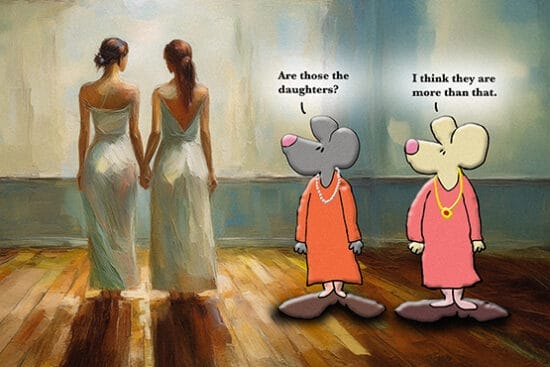
Not too terribly long ago, I was talking with an acquaintance, and they said something along the lines that I must be familiar with The Daughters of Bilitis. Well. The fact of the matter was, I had no idea who The Daughters of Bilitis were or are.
Apparently, they have had a big spot in history for a group I’m identified with. It seems that history will remember those movements that make a large impact. Those marches. Or headlines. Court cases. And more.
But most movements don’t start with a lot of steam. Sometimes they begin in a living room. Like, somewhere in California on a quiet night. With eight women who are not trying to make history. They sit around that living room talking, only because they are trying to make life a little easier for themselves and others like them.
On September 21, 1955, in San Francisco, four lesbian couples gathered in a private home and formed what would become the first lesbian rights organization in the United States: The Daughters of Bilitis. So there it is.
The 1950s. Sadly, this was not a safe time to be visible. Most gay and lesbian Americans lived deeply closeted lives. Police raids were common. Surveillance was real. The FBI and CIA kept files. Freedom could disappear with a single accusation.
So these eight women did not begin as activists. They began as people looking for one another.
Bars were dangerous places. Raids were frequent. So the Daughters of Bilitis started as a social alternative, a way to gather without fear. It was their way to create a connection. It was hard to do such a thing, where no connections seemed to exist.
The name they chose was deliberately obscure. They borrowed it from The Songs of Bilitis, which was a collection of erotic poems linked to Sappho. It sort of sounded academic. At least to outsiders, it sounded that way.
At any rate, their group took hold.
As time went on, the meeting and the ideas got more involved. In 1956, the group took another brave step. They began publishing The Ladder. This little publication was the first nationally distributed lesbian magazine in the United States.
They were careful about how they did this. And measured. Careful and cautious. But the very fact that they produced this magazine was radical. Each issue got a little more visibility and connection
.
The Daughters of Bilitis would eventually grow into a national organization. It did a lot of work in navigating internal tensions over feminism and activism.
But. By the late 1970s, the group sort of faded. A larger movement was taking hold.
But fading is not necessarily failure.
Some things existed so that others can follow in their footsteps.
The Daughters of Bilitis created a community where there had once been isolation. They offered safety where there had been fear. They proved that even in a hostile world, people will find one another.
The gay community today has more visibility than ever. But many in this country and this world truly hate us. They think we are sinners, or worse yet, mentally ill. I can not begin to tell you how much it hurts to be regarded in this manner.
I feel the need to tell you their names. They were, courageously, Del Martin, Phyllis Lyon, Rosemary Sliepen, Marcia Foster, Mary Stearns, Helen Sandoz, Gene Damon, and Rose Bamberger.
“””””””””
“Never doubt that a small group of thoughtful, committed citizens can change the world.”— Margaret Mead
“””””””””
“History is not the past. It is the present. We carry our history with us.”— James Baldwin
“””””””””
“The most courageous act is still to think for yourself. Aloud.”— Coco Chanel
“””””””””
“We were not wrong. We were just early.”— Del Martin
“””””””””
“There is power in naming yourself.”— Gloria Anzaldúa
“””””””””
“Some revolutions begin with a whisper.”— Rebecca Solnit
“””””””””


