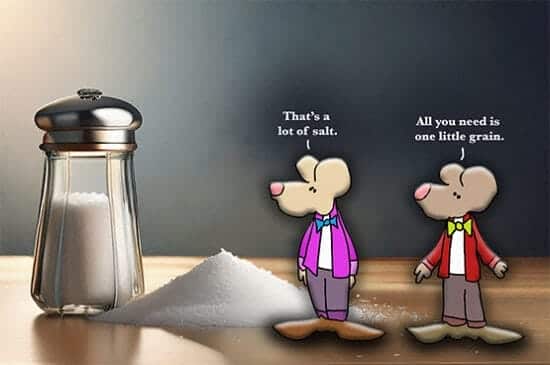
Take It With a Grain of Salt.
We know the phrase, and I imagine that we’ve all said it at one time or another.
“Take that with a grain of salt.”
It’s what we say when something sounds a little questionable. Perhaps we’ve been given information, and we’re passing it on to someone else. But it might sound a bit contrived or a little exaggerated. So that’s when we pull out the salt shaker.
Speaking of salt shakers. I eat a lot of salt.
So now we’re on a slight sidebar.
I’ve had three different doctors recommend that I eat as much salt as possible. For the past “forever” years, the sodium levels in my blood tests have been extremely low. This can cause big problems, like headaches, nausea and vomiting, seizures, coma, nerve signal damage, muscle weakness, cramping, and more. They’ve tested me for everything under the sun, and they can’t figure out why it is happening. So as a result, I’m only allowed to drink 50 ounces of fluid each day. Which sucks. And eat copious amounts of salt, which makes me thirsty. Plus, all this salt is now inching up my blood pressure.
I’ve been to two different specialists over the years. And so it goes.
My longtime general practitioner hates that we haven’t been able to figure it out.
So. In my world, taking it with a grain of salt is a frequent occurrence.
But back to the phrase, and its history.
The meaning is simple enough: approach something with skepticism. Consider the source. Question the validity of the statement.
Here I should insert another sidebar. We would be well served if we took online news, talk jocks, and social media with a grain of salt.
And I’ll tell you why.
Headlines are designed to grab attention. They often use dramatic or emotional wording that can exaggerate the real story. Also, those darn algorithms. They tend to show you more of what you already engage with, which can create echo chambers and reinforce existing beliefs. Maybe worse than anything is the fact that reporting and “opinion” frequently live together. This makes it very hard to separate verified facts from commentary.
The bottom line is this. Misinformation spreads easily. Conflict and outrage attract viewers. These sources guide people in the direction they want to go.
So take it ALL with a grain of salt.
But back to this little phrase. Just where did this come from?
The story often traces back to 77 CE, when the Roman author Pliny the Elder was translating an ancient text. In his work, he described how, after the defeat of King Mithridates, Gnaeus Pompeius (Pompey the Great) found a handwritten antidote recipe in the king’s private cabinet.
Here was the recipe:
Two dried walnuts.
Two figs.
Twenty leaves of rue.
All pounded together.
With the addition of a grain of salt.
According to the text, if someone took this mixture on an empty stomach, they would be protected from poisons for the day.
The “grain of salt” wasn’t symbolic back then. It was literal. The idea was that the salt might lessen harmful effects. It was added as a protective element to the antidote.
And there you have it.
But, over time, scholars studying ancient Greek and Roman writings interpreted this passage. By the 17th century, the phrase began appearing in English. In British English, it became “with a pinch of salt.”
Then, for some odd reason, the expression disappeared for a while. Like, for centuries.
And then poof. It began reappearing in the 20th century with the meaning we use today.
Be skeptical. Don’t accept something at face value.
Which is kind of perfect, isn’t it?
But the funny thing about all of this? The origin story of “take it with a grain of salt” isn’t 100 percent nailed down. There is some speculation there.
So perhaps the wisest thing to do is to take that explanation with a grain of salt.
“”””””””””
“Believe nothing you hear, and only one half that you see.”
— Edgar Allan Poe
“”””””””””
“The trouble with the world is that the stupid are cocksure and the intelligent are full of doubt.”
— Bertrand Russell
“”””””””””
“The eye sees only what the mind is prepared to comprehend.”
— Henri Bergson
“”””””””””
“Where all think alike, no one thinks very much.”
— Walter Lippmann
“”””””””””
“The problem is not that people are ignorant. It’s that they know so much that isn’t so.”
— Josh Billings
“”””””””””