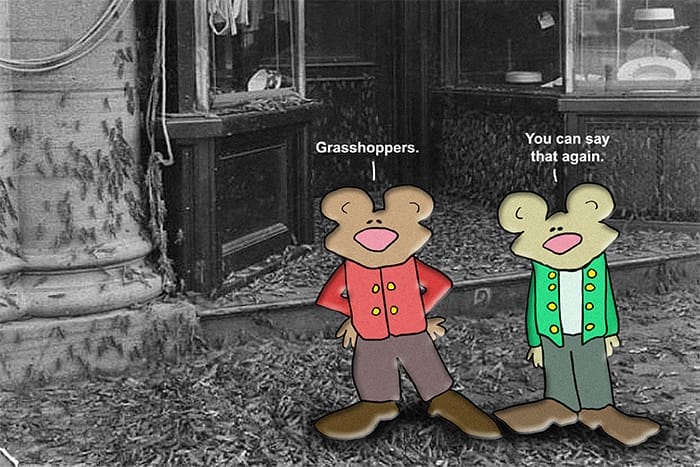
And then. There was the time.
When Grasshoppers Ate South Dakota
Sometimes, life gets hard. Unthinkably hard.
In that case, let’s take a trip back to July of 1931. The United States was right in the middle of the Great Depression. Life was really hard for people back then. Everywhere.
But the farmers in South Dakota were barely hanging on by a thread. Money was scarce. Rain was scarce. And then came a crazy stroke of bad luck. Grasshoppers.
Typically, I love a grasshopper. I think they are the jam. But in South Dakota, there were more than just a few hopping across the garden. They had a plague of them. The swarms were so thick that they darkened the sky and left entire fields looking like somebody had taken a giant eraser to the crops.
Governor Warren Green of South Dakota was desperate. On July 14, he sent a plea straight to President Herbert Hoover, warning that 11,000 square miles of farmland had been utterly destroyed. His message was blunt. Without federal help, his state’s farmers were facing “intense suffering.”
And the suffering was very real. These weren’t the migratory locusts of biblical fame, but an “exceptionally greedy” grasshopper variety that chewed through millions of acres in the Midwest that summer. Cornstalks were gnawed down to nubs. Hay, wheat, and oats were completely gone.
Eyewitnesses recalled scooping grasshoppers with shovels, as if they were piles of coal. Some said the swarms were so dense they blocked out the sun.
Thankfully, plagues of this magnitude haven’t been seen in the U.S. since the 1930s. The reason? Well, it might be a few things like the advances in farming and pest control. Or, maybe it is just sheer luck.
It’s a sobering reminder that nature doesn’t always play fair. In 1931, farmers learned firsthand just how quickly abundance can flip into ruin.
Hardship comes in many shapes and sizes, it seems. It can be huge and overwhelming. Or it might be in those quiet battles no one else sees.
Life has a way of testing us in ways we never imagined. Sometimes it forces us to start again. Mostly, though, with love in our hearts, we find a way to endure.
“””””””
“The locusts came, without number, and did eat up every herb in the land, and all the fruit of the trees.” — The Bible, Exodus 10:15
“””””””
“Hardship often prepares an ordinary person for an extraordinary destiny.” — C.S. Lewis
“””””””
“Nothing is permanent in this wicked world—not even our troubles.” — Charlie Chaplin
“””””””


