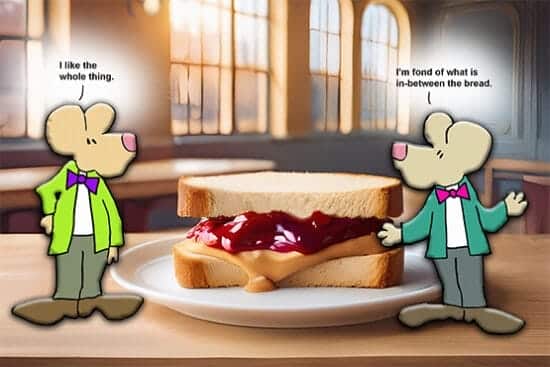
Let me tell you about one of my favorite things in all my life. That is the peanut butter and jelly sandwich on soft white bread. I haven’t had one for years. Decades. But I used to love them dearly when I was young.
Of course, most people like them. A survey once found that about 72% of respondents said they enjoy peanut butter and jelly sandwiches. And the average American eats about three PB&J sandwiches per month as an adult.
Who could imagine growing up without the PB&J sandwich? Well. It turns out that this good treat is a fairly modern invention. It is very American. And it was born out of convenience, mostly.
Peanut butter itself didn’t become common until the late 1800s. Peanuts have been around forever. But. Grinding them into a smooth and spreadable paste meant that there had to be industrial-type milling.
Jelly (and jam) is older. Fruit preserves date back centuries. It was used as a way to keep fruit edible after harvest. I mean, it is old. The earliest known fruit preserves date back to ancient Mesopotamia and Egypt. That was roughly 3000–2500 BCE. People discovered that cooking fruit with honey helped it last longer.
And then it evolved. By the early 1900s, jams and jellies were being mass-produced and were widely available in the U.S.
So. How did the two of these meet? The first known suggestion of combining peanut butter with jelly appeared in 1901. That is when Julia Davis Chandler published a recipe in The Boston Cooking-School Magazine. At the time, this pairing was considered novel. People thought it was fancy.
But it took a war to give the sandwich its oomph. PB&J really came into American legend during World War II. The U.S. military included peanut butter, jelly, and bread in soldiers’ rations. It was a great meal for them in that wartime. It was calorie-dense and protein-rich. Plus, it didn’t spoil, and they didn’t have to cook it. All those good soldiers came home with a taste for the PB&J. So the sandwich followed them back to America and their civilian lives.
By the 1950s, PB&J wasn’t just food. It was goodness. Iconic.
Which makes me think about the things that are in between.
The in-between. That is a good thing, I think. We’re taught to notice and celebrate the big things.
Birthdays with candles. Huge events. Vacations. Milestones.
But truly? Most of life doesn’t happen during those big occasions. Most everything happens in the spaces between.
It is all in the in-between. Between the moment something ends and whatever begins next.
Those in-between times are just our ordinary days. No cakes with candles. No big whoop-dee-dos. And yet, that is where life actually unfolds.
Here is the trick. When we are in those ordinary stretches of time, we can become awake to the small, sustaining joys. All the millions of little good things. Our hearts are beating. We are able to eat food. Our ears work. We have a favorite chair by a window. We just found another good book to read. We are able to take in a breath of fresh air.
All of this reminds us that we’re still living, and that is good.
Sometimes we miss the truth hiding in plain sight. We have so many gifts in every day. Most of us do, at least. These simple experiences that are truly amazing.
Good things in life are found in the spaces in between them.
Like the very center of a peanut butter and jelly sandwich. On soft, white bread.
“”””””””
“Sometimes the smallest moments take up the most room in your heart.” — A. A. Milne
“”””””””
“Happiness is not in another place, but this place.” — Walt Whitman
“”””””””
“Wherever you are, be all there.” — Jim Elliot
“”””””””
“The present moment is filled with joy and happiness. If you are attentive, you will see it.” — Thích Nhất Hạnh
“”””””””