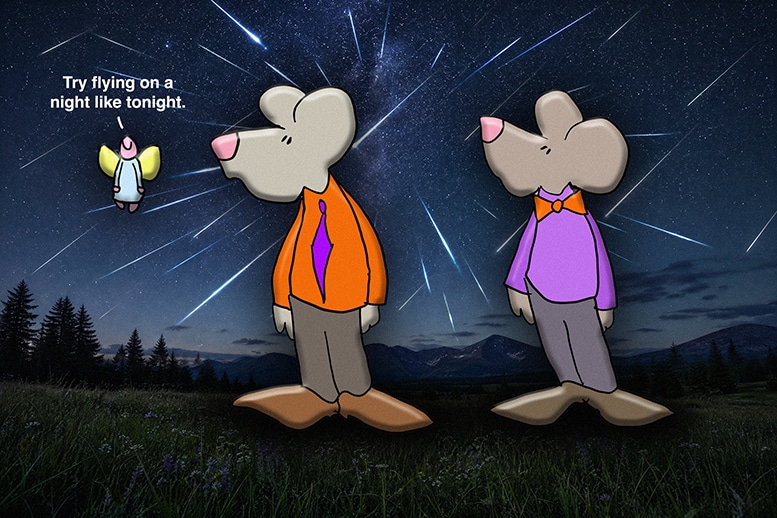
Have you ever heard of the Leonids?
Not the Leonard Nemoys. Although they are close. Both hang out in outer space.
This is the first time I ever remember hearing of them.
The Leonids are an annual meteor shower that occurs every November, usually reaching its peak around November 17 or 18. They get their name from the constellation Leo, because the meteors appear to originate from that part of the sky.
The Leonids are caused by tiny particles of dust and debris left behind by the Comet Tempel-Tuttle, which travels around the Sun approximately once every 33 years. When Earth passes through this debris, the particles enter our atmosphere at tremendous speeds, creating bright streaks of light.
Most of those particles are no bigger than grains of sand.
And I might add here. I love the name of that comet. Comet Tempel-Tuttle.
Anyway, in an ordinary year, the Leonids might produce around 10 to 15 meteors per hour under favorable viewing conditions. But approximately every 33 years, Earth encounters particularly dense trails of comet debris. The Leonids can produce a meteor storm involving hundreds or even thousands of meteors per hour when this happens.
And that brings me to something extraordinary that happened in 1833.
On the night of November 12 and into the early morning of November 13, people across eastern North America witnessed one of the most spectacular meteor storms ever recorded.
The stars appeared to be falling.
And not just a few of them. Lots. And lots.
Some estimates suggest that tens of thousands of meteors were visible per hour at the storm’s peak. They streaked across the dark night sky in every direction. I can’t even imagine.
It was 1833. There was no television or radio or internet. There was no mass media to explain what was happening. No weather apps sending alerts. Without widespread electric lighting, the night sky was much darker than the one most of us see today.
People freaked out. They woke their families and neighbors. Some fell to their knees and prayed. Others were convinced that Judgment Day had arrived and the world was coming to an end. In the moment, no one knew what was happening.
Newspapers later published extraordinary accounts and illustrations of the event.
But something else happened as a direct result.
My old pal science.
At the time, scientists were still trying to understand meteors. Some believed they were atmospheric phenomena rather than objects arriving from space. The extraordinary display of 1833 provided researchers with observations from many different locations.
The storm helped astronomers recognize that meteor showers followed predictable patterns. Further research eventually connected the Leonids to Comet Tempel-Tuttle.
So there they are. The Leonids.
They occur every year, but the spectacular meteor storms are much rarer. Although the comet returns approximately every 33 years, a major storm isn’t guaranteed with each return. It depends on whether Earth passes through a particularly dense concentration of debris.
Another little bit of goodness. Brought to you by the Universe.
“”””””””
“Somewhere, something incredible is waiting to be known.” — Carl Sagan
“”””””””
“For my part I know nothing with any certainty, but the sight of the stars makes me dream.” — Vincent van Gogh
“”””””””
“Dwell on the beauty of life. Watch the stars, and see yourself running with them.” — Marcus Aurelius
“”””””””
“Equipped with his five senses, man explores the universe around him and calls the adventure Science.” — Edwin Hubble
“”””””””