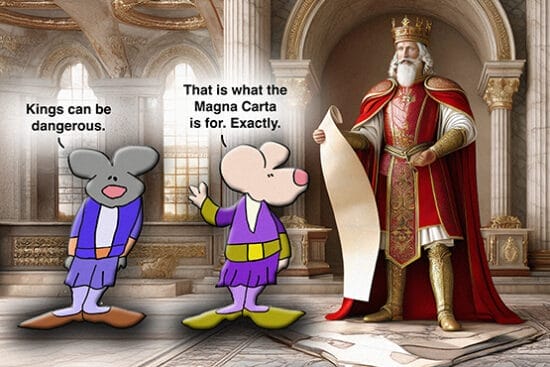
Here is something I’d like to tell you about. Especially in these times in the United States. It is the Magna Carta.
The Magna Carta (Latin for “Great Charter”) is one of the most important legal documents in history. It was issued in 1215 in England. It is so very important because it fundamentally changed how power, law, and rights were understood.
The Magna Carta was an agreement between King John of England and a group of rebellious barons. Apparently, the king had been ruling harshly. That guy was raising taxes, seizing property, and imprisoning people without fair trials. So. The barons forced him to accept limits on his authority.
I’ll say it again. Limits on authority.
So yes. For the very first time, a monarch formally acknowledged that the king is not above the law.
It all happened at a meadow called Runnymede, beside the River Thames. That is where King John pressed his seal onto a document he did not want to sign.
The Magna Carta. It was not written to inspire future democracies. Nope. In truth, it was a peace treaty. A last resort. It ended up being a concession that was pulled from a ruler who had pushed too far.
John hadn’t been doing so great as a king. He had lost wars. He drained coffers. And then, he taxed the nobility mercilessly. Not to mention that he had tangled himself in bitter disputes with the church.
Well. Those barons had had enough. They rebelled. The king gave in because he was faced with superior force.
The document that emerged was not a declaration of universal freedom. It was highly specific. It contained sixty-three clauses dealing with land, inheritance, church authority, and royal abuse.
And tucked inside that very practical document was a radical idea for its time. The king himself was subject to the law.
Clause 39 would have huge effects far beyond medieval England. It declared that “no free man could be imprisoned or punished except by lawful judgment or the law of the land.” The world was accustomed to absolute rulers. This clause put forth an incredible shift.
In the short term, Magna Carta failed. Civil war erupted. John ignored its promises. But after his death, the charter was revived, revised, and reissued. Slowly, it took hold. It transformed from a political compromise into a symbol. It began to move in the right direction because it insisted that power had limits.
Centuries later, its spirit crossed the Atlantic. Ideas seeded in Magna Carta shaped the American Constitution. Trial by jury. Due process. Habeas corpus. The belief that rulers answer to law, not the other way around.
What an amazing thing when history turns for the good.
I feel that all of it is being slowly destroyed by our current administration. Sadly.
““””””””
“Law is reason, free from passion.” — Aristotle
“”””””””
“Where law ends, tyranny begins.” — John Locke
“”””””””
“The history of liberty is the history of the limitation of governmental power.” — Woodrow Wilson
“”””””””
“The price of freedom is eternal vigilance.” — Thomas Jefferson
“”””””””


