Cars. We all know them, and we all drive them. They take us to and fro.
When they were invented, they were meant for transportation. But it didn’t take long before they became a sport. People driving those cars at high, high speeds.
There have been many of those drivers throughout history. Unfortunately some of them ended their lives while racing.
With that said, some tragedies are more shocking than others. The ones that shook the entire sport to its core.
One of those days was June 11, 1955, at the “24 Hours of Le Mans” in France.
The Le Mans race had been running since 1923. That race was a brutal test of humans and machines. And maybe more than anything, it was a test of endurance and stamina.
Drivers would push through a full day and night on winding roads near the town of Le Mans. It drew a lot of attention. Fans crowded into grandstands just to get a glimpse of the race. That year, in 1955, the crowd would get more than just the race. They would see a terrible horror unfold.
Pierre Levegh, a French driver who nearly won the race solo just three years earlier, had joined the mighty Mercedes-Benz team. He had voiced concerns about how dangerously narrow the track was near the pit-stop area and stands. As it turned out, his very words proved hauntingly true.
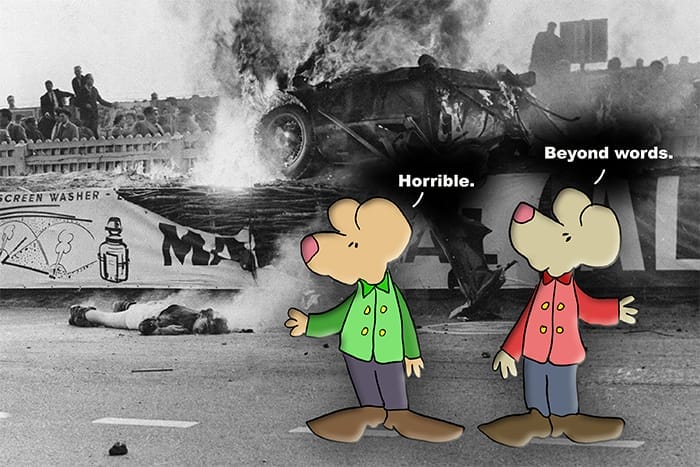
As Levegh raced down the straightaway at roughly 150 miles an hour, he swerved to avoid a car heading into the pits. Just like that, in the blink of an eye, his Mercedes clipped another racer’s vehicle.
His car launched into the air and exploded into the packed grandstand. The jagged debris from his car was on fire. It sailed through the air and rained down on the spectators. Levegh and more than 80 fans were killed instantly.
Unbelievably, the race didn’t stop. Organizers kept it going, saying that an evacuation might have blocked ambulances trying to reach the wounded.
Mike Hawthorn, whose Jaguar had triggered the chain of events, went on to win that race. I don’t know quite what to say about that. And then there was the rest of Levegh’s Mercedes team. They withdrew from the race immediately.
In the aftermath, countries like Spain, Mexico, Switzerland, and Germany temporarily banned racing. Safety standards would eventually improve.
But the 1955 Le Mans disaster remains the darkest day in motorsport history. It is a reminder of how thin the line can be between enjoyment and catastrophe.
Many people love the thrill of danger. Racing is one of those things with the blur of speed. But the price of those races can be steep. And sometimes, it’s paid in human lives.
This is something that occurs, not only in racing, but in the world around us, in ordinary things. It is worth repeating. Sometimes the price of the frivolity can be steep and hard.
“”””””””
“Speed has never killed anyone. Suddenly becoming stationary—that’s what gets you.” — Jeremy Clarkson
“”””””””
“You try to win a race, but sometimes the race wins you.” — Mario Andretti
“”””””””
“Sometimes, the spectacle blinds us to the cost. But history never forgets the price paid.” — Jonathan Thompson
“”””””””


