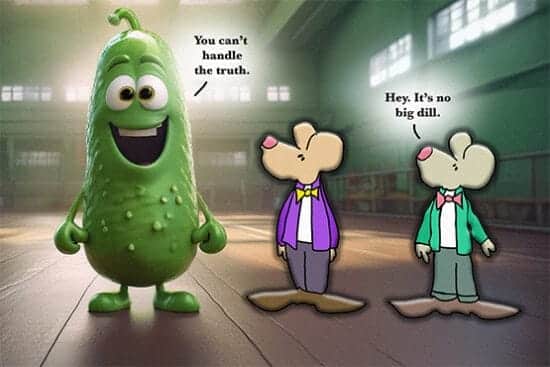
Just remember. It’s no big dill if we ever get into a pickle.
Oh. I do love a pickle. Not the trouble kind. But the kind that you eat.
I love a cheeseburger with mayonnaise and lots of pickles. Oh, it is the best.
As such, I once had a Wendy’s employee admit to me that she drank pickle juice, right out of the jar while standing with the refrigerator door open. This, all a secret to her husband of 40 years.
And so it goes. People love pickles
They have been around for a long, long time. We’re talking thousands of years.
Believe it or not. As early as 2030 BCE. That is when people soaked cucumbers in salty, acidic brines in Mesopotamia. They did this so their cukes could survive long journeys. Preservation was the goal. As a result, the big bonus was the flavor.
Pickles have been all over the place. Ancient texts from China mention pickled foods more than 9,000 years ago. Cleopatra supposedly credited pickles with helping maintain her beauty. Julius Caesar and Napoleon were fans. And ships crossing the Atlantic hundreds of years ago bought pickles along to help prevent scurvy among crew members.
The word pickle is that way for good reason. It likely comes from the Dutch pekel or the northern German pókel. Both of these mean salt or brine.
Then pickles went big.
In the late 1800s, H. J. Heinz Company introduced commercially produced pickles. They hit marketing gold at the 1893 World’s Fair with a tiny pickle-shaped pendant. It was a free giveaway that helped launch Heinz’s “57 varieties.” And that is when the pickle officially entered American mass culture. Soon after that, other brands came forward. Clausen, Mount Olive, Vlasic.
But how did the dill pickle become the sidekick to the deli sandwich?
That credit goes largely to Jewish immigrants who opened delis in New York City in the early 20th century. Dill pickles were served as palate cleansers. It served as something acidic and crunchy to cut through rich, fatty meats. They were cheap, required no prep, and worked perfectly. It quickly became a standard.
There is a little science to all of this. To pickle something is simply to preserve it. Vinegar-based brines use acidity to block harmful bacteria. And salt-brining relies on fermentation, encouraging good bacteria to do the work. Dill pickles often fall into that fermented category, which explains their deeper, tangier flavor.
So there it is. Coolio. The great pickle.
And I’ll tell you this much. It is as cool as a cucumber.
“””””””“
Life is a combination of magic and pickles.”
— Federico Fellini
“””””””“
“Everything tastes better with a pickle.”
— Nora Ephron
“””””””“
“The discovery of a new dish does more for human happiness than the discovery of a new star.”
— Jean Anthelme Brillat-Savarin
“””””””“