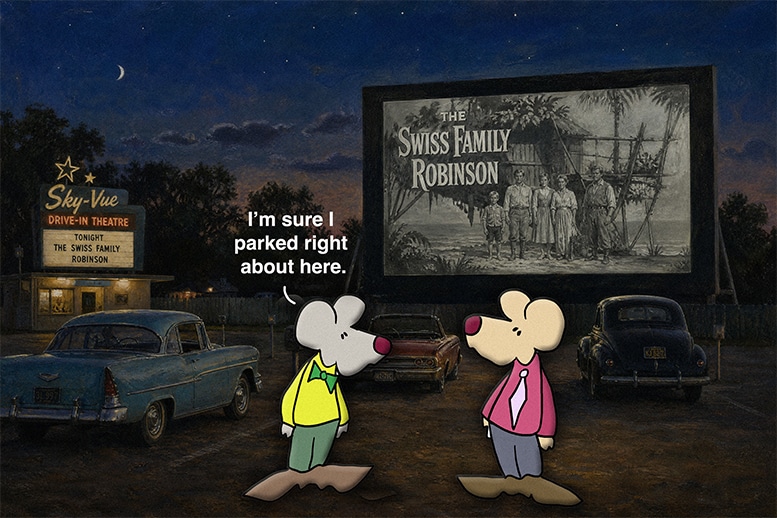
I love a good movie. I’ve said it before.
But here is a side of the movies that only some of us remember. The drive-in.
I’ve only done this a couple of times. And I was less than ten years old on all accounts. I watched some wonderful movies from the top of our station wagon, eating popcorn, hot dogs, and M&Ms. It was exactly like magic, I’ll tell you.
Yes. The good old drive-in theater.
They’ve been around much longer than I thought. The first drive-in movie theater opened on June 6, 1933, in Pennsauken, New Jersey.
It all started with a guy named Richard Hollingshead. A guy who loved movies. Hollingshead worked as a sales manager for his father’s auto-products company.
According to the story, Hollingshead’s mother was a rather large woman who loved going to the movies but found the narrow theater seats uncomfortable. Hollingshead realized she was far more comfortable sitting on the wide bench seat of an automobile. And that became his idea. Why not let people watch movies from their cars?
So he experimented like all scientists/sales managers do.
In his own driveway, Hollingshead mounted a 1928 Kodak projector on the hood of his car. Then, he hung a screen between trees. He placed a radio behind the screen for sound. Finally, he experimented with different arrangements of vehicles so everyone could see.
He even tested what would happen when it rained.
All of this was enough to make his idea catch on.
Hollingshead received a patent for his newfound project in May 1933 and opened his theater less than a month later. It was originally called a “Park-In Theater.” The term “drive-in” became popular later.
Admission was 25 cents per car plus 25 cents per person, although no group paid more than a dollar. Our family would have been a steal with seven kids and two parents. We’d get five people in for free. More money for food and sodas at the snack shop.
Anyway, back to Hollingshead. His idea eventually took off in a big way.
After World War II, drive-ins became increasingly popular, reaching their golden age during the late 1950s and early 1960s. At their peak, there were thousands across the United States.
Some were enormous. The All-Weather Drive-In in Copiague, New York, could accommodate about 2,500 cars and even had a playground and restaurant. That is one big drive-in.
But you know. At the heart of this. Drive-ins became more than places to watch movies. They were family outings. They were teenage gathering spots. More than anything, they had become a big piece of summertime Americana.
Sadly, eventually, they slipped away into obscurity. The cause? Rising land values, indoor multiplexes, and home video. All of these things caused their numbers to dwindle.
And yet. The drive-in never disappeared completely. Today, fewer than 500 drive-in theaters survive in the United States. That rounds out to about ten per state.
I think it is cool how it all started, though. One smart guy, who loved his mother, experimenting in his driveway. Putting a projector outdoors for all to see. All to make movie night a little more comfortable.
Wonderful inventions. Sometimes a good invention begins with a complicated scientific problem. And sometimes it begins because Mom needed a better chair.
“””””””
“Everything you can imagine is real.” — Pablo Picasso
“””””””
“There’s no business like show business.” — Irving Berlin
“””””””
“Nothing is ever really lost to us as long as we remember it.” — L. M. Montgomery
“””””””