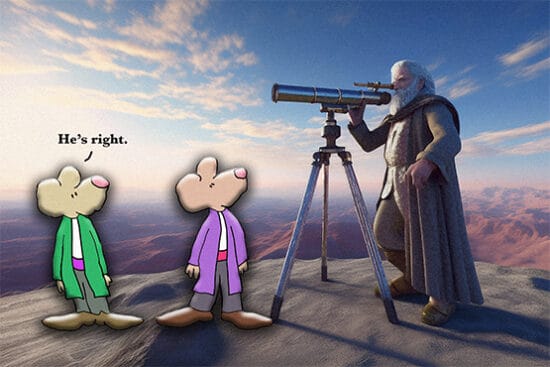
I really, really like Galileo, I’ll tell you. I mean, I really, really like Albert Einstein, and Einstein once called Galileo the “father of modern science.”
Why did Albert say that? Because Galileo emphasized observation, experimentation, and mathematics to understand how nature works. He tried and failed and tried again, until he proved things right.
Galileo was one of the first scientists to study motion and falling objects through experiments rather than philosophy alone. According to legend, Galileo dropped objects from the Leaning Tower of Pisa to test how gravity worked. There’s probably a hefty fine if you did that nowadays.
Anyway, he was a wizard when it came to Astronomy and figuring out the planets, the suns, the moons, and all else.
But today I am writing of his troubles. He ran into this trouble because people didn’t want to believe in science.
It started in 1633. That is when Galileo Galilei faced one of the most famous trials in scientific history. On April 12 of that year, he appeared before the Roman Catholic Church’s Holy Office after being accused of heresy. You see, he supported the idea that the Earth revolves around the sun. Yeah. Science.
At the center of the conflict was the Copernican theory. This was first proposed by astronomer Nicolaus Copernicus. He argued that the Earth and other planets orbit the Sun. Church authorities considered this belief dangerous because it appeared to contradict accepted interpretations of scripture.
Galileo had already been warned in 1616 not to defend or promote the theory publicly. That whole non-science thing.
But he knew he was right. So. Despite that warning, Galileo continued writing about the subject. In his 1632 book, Dialogue Concerning the Two Chief World Systems, he examined arguments for both the Earth-centered and sun-centered models of the universe.
Although he claimed the work was intended as a discussion rather than a declaration of belief, Church officials believed he had clearly supported heliocentrism. And they gave him the big “Tsk. Tsk.” They put him on trial.
The court hammered him. On June 22, 1633, the Church formally declared him “vehemently suspected of heresy.” His book was banned, and he was ordered to abandon his support of the Copernican system.
Galileo avoided imprisonment in a traditional cell, but he was sentenced to house arrest for the remainder of his life. He was also required to recite the Seven Penitential Psalms weekly for three years as an act of penance. (Psalm 6, Psalm 32, Psalm 38, Psalm 51, Psalm 102, Psalm 130, Psalm 143)
Confined to his home, Galileo continued working privately on scientific studies until his death in 1642.
I always say, “Science Rules.” And so it went. More than three centuries later, the Catholic Church officially acknowledged that errors had been made in the handling of Galileo’s case.
You think? Oh wait. Do we really rotate around the sun? Just like he said?
His trial has since become a huge reminder of the tension that can arise between scientific discovery and established authority. Or more to the point: The conflict between scientific discovery and those who choose to believe self-serving lies.
“””””””
“The important thing is not to stop questioning.” — Albert Einstein
“””””””
“All truths are easy to understand once they are discovered; the point is to discover them.” — Galileo Galilei
“””””””
“In questions of science, the authority of a thousand is not worth the humble reasoning of a single individual.” — Galileo Galilei
“”””””
“Equipped with his five senses, man explores the universe around him and calls the adventure Science.” — Edwin Hubble
“””””””