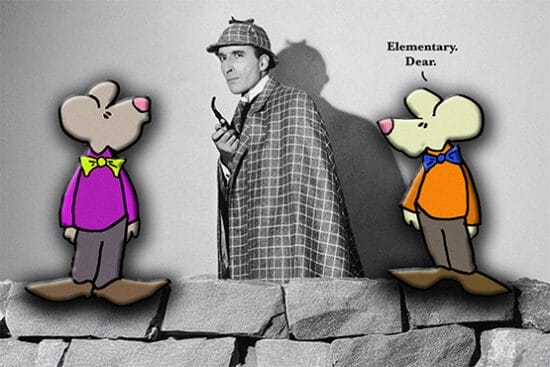
How many of us have traveled to 221B Baker Street, London, England, and spent a fair amount of time in the parlor there, sorting out ideas? If I were a betting woman, I’d say most of us know that place, either through books or through film.
Yes, the great mysteries of Sherlock Holmes and his sidekick, James Watson. Of course, the stories were created by master sleuth-writer, Sir Arthur Conan Doyle. Like Sherlock, Doyle was a bit of a mystery himself.
It’s true. Doyle was fiction literature’s great champion of logic. But in the real world, he spent much of his own life chasing mysteries of a very different kind.
Many people don’t know that Doyle was trained as a medical doctor. He was a smart guy, too, educated at the University of Edinburgh. And it was at Edinburgh, where careful observation and diagnosis were drilled into him. Those college-day skills would later shape Sherlock Holmes’s razor-sharp deductions.
But here is the thing. Outside of fiction, Doyle often leaned toward “belief” rather than “skepticism.” I think, like me, he believed in the possibilities of the Universe.
In fact, in his later years, he became deeply devoted to Spiritualism. He held a séance. He wrote books about communicating with the dead. And he also insisted that the spirit world was not only real, but provable. In one of my books, I touch upon this. Doyle was a member of The Ghost Club. (For the record. I’ve never held a séance. And I haven’t had any two-way conversations with the dead.
Anyway, back to Doyle. This belief famously put him at odds with Harry Houdini. The two of them were really good friends. They had a great relationship that was bonded by curiosity and intellect.
But then the “thing” happened. Doyle’s family held a séance one night. During the “connections,” they claimed to contact Houdini’s deceased mother. They even produced messages written in English. But that was a language Houdini’s mother never spoke. So. Of course, Houdini was skeptical and unconvinced. But Doyle refused to doubt it. He was all in on those happenings. And as such, Houdini and Doyle’s friendship never recovered.
Doyle’s realm of exploration didn’t stop there. He believed in fairies after viewing the now-debunked Cottingley photographs. (About these photos. In 1917, two cousins, Elsie Wright (16) and Frances Griffiths (9), took a series of photos in Cottingley, England. The photos showed Frances posing with small, winged fairies. The images looked real. Experts of the era found no obvious signs of double exposure. But they were faked by the two girls. Regardless, Doyle spent money and reputation defending their authenticity before the truth came out.
But on the flip side of that, Doyle, this same man who believed in faerie photos, was a master mind of reason. Yes, in real life, Doyle helped to clear a man named George Edalji, who had been wrongly convicted of animal mutilation. Doyle noticed mismatched soil, a bloodless razor, and poor eyesight. These three parts of the case helped prove Edalji’s innocence. And, his work eventually led to reforms in the British legal system.
There is way more to know about Sir Arthur Conan Doyle. He ran twice for Parliament. Despite being famous (Sherlock Holmes was already a household name), his political views, especially his strong support of the Boer War, were unpopular with many voters. Speaking of which, he wrote propaganda during the Boer War and was knighted for it. (And I didn’t know what the Boer War involved. So here it is. This was a brutal conflict fought in South Africa from 1899 to 1902. It was mainly between the British Empire and two small, independent Boer (Dutch-descended settler) republics.
He promoted skiing in England. Doyle played first-class cricket, boxed, fenced, golfed, and more.
So there are a few facts about Sir Arthur. His life shows us that brilliance rarely travels in straight lines. This guy was a little bit of everywhere. He had both logic and belief. He was inspired by both reason and wonder. He looked at the world he could see and the world he could not see.
Maybe we are all this way. And maybe not.
“””””””””
“Mediocrity knows nothing higher than itself.” — Arthur Conan Doyle
“””””””””
“The world is full of obvious things which nobody by any chance ever observes.” — Arthur Conan Doyle
“””””””””
“The human mind delights in mystery.” — Agatha Christie
“””””””””