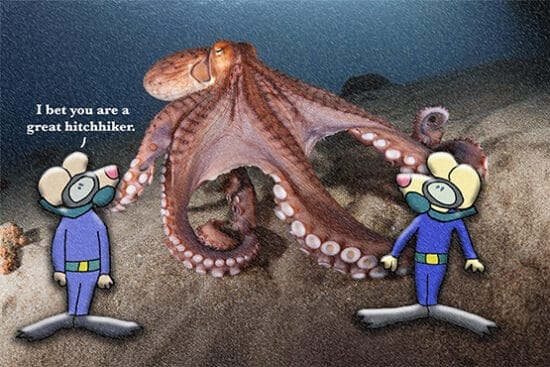
Octopuses are extra smart, I’ll tell you. Most people don’t really like them very much because they look “strange” by human standards. But really? They are way cool. They are extra wonderful if you ask me.
So today, I’m bringing it home for the octopus.
First of all, as I mentioned, they’re incredibly intelligent. In fact, octopuses are considered the most intelligent invertebrates on Earth. They know how to solve puzzles and mazes. They can open jars. Even jars and lids that are child-proof. They can figure out how to open locks. And so much more.
Octopuses learn by watching other octopuses, too. They can also remember solutions and apply them later. And. Some have been observed escaping tanks, crawling across floors, and returning to the ocean. Some have been seen sneaking into neighboring tanks for snacks. Have you seen the movie Finding Dory, which was the sequel to Finding Nemo? Well, all those octo-antics are true.
Their minds are great. But so are their bodies.
I mean, who else has eight arms?
And to top it off, they have three hearts. Two of those hearts pump blood to the gills. And the other one pumps blood to the rest of the body.
Here is something most people don’t know, though. When an octopus swims, the main heart actually stops beating. Because of this, swimming is exhausting for them. That’s why they prefer crawling along the seafloor.
And you’ve heard of the show Blue Bloods? Well, the octopus really has blue blood. Octopus blood uses hemocyanin, a copper-based molecule, instead of iron-based hemoglobin. To note: Copper binds oxygen more efficiently in cold, low-oxygen water. As a result, their blood is blue instead of red. In case anyone asks you at the dinner table tonight.
Even though its brain probably runs the show, the octopus really has eight more brains in its arms. You see, most of their neurons are in their arms. And each one of those arms can taste and touch. They can decide how to move independently. They can change color, texture, and shape instantly
.
Octopuses have specialized skin cells that can change color. They also have muscles that change skin texture. They can go from smooth to spiky, just like that. They can blend in looking like coral, rocks, sand, or seaweed in milliseconds.
It just keeps getting better and better when it comes to the octopus. Some species mimic other animals. Like. They do impersonation. Sea snakes. Lionfish. Flatfish. Whatever a Flatfish might be. (But I bet it is flat.). They choose which animal to mimic based on what predator is nearby.
Okay. One more thing. They squirt out ink. They do this to use as a misdirection when they feel they might be in danger. The ink creates a dark cloud to block vision, and it sometimes forms a decoy shape of the octopus.
Sadly, they only live 1–3 years. As the Billy Joel song goes, “Only the good die young.”
And I surely do think that the octopus is really good. One of the good, good animals on this Earth.
“”””””””
“The octopus is an animal that seems to have escaped from a different evolutionary universe.”
— Peter Godfrey-Smith
“”””””””
“The octopus challenges our ideas of what intelligence looks like.”
— Sy Montgomery
“”””””””
“Octopuses are masters of disguise, escape, and invention.”
— National Geographic marine science editorial
“”””””””