I love art. I am especially drawn to paintings. I could spend a lot of time in nearly any art museum. I know this because I’ve spent a lot of time in art museums.
The thing about a painting is that it comes with a story. Maybe not outright. But it has a lot of information that goes way beyond those brushstrokes on the canvas.
Over time, some of these things become hardened into “facts,” even when the artist never meant them to be facts at all. And just when we think we know a painting, we really do not quite know it at all.
Here are a few famous paintings that have been completely misunderstood for a long time running.
American Gothic by Grant Wood.You know it. The stern-looking farmer holding a pitchfork and the serious or sad woman standing next to him. Well, they are not a married couple. Nope. Not husband and wife. The pair in American Gothic are always thought to be. But Grant Wood intended them to be a farmer and his daughter. He even used his sister and his dentist as models.
The Persistence of Memory By Dali.Those are Dalí’s melting clocks. They weren’t about Einstein as often perceived. Those drooping clocks look like a deep meditation on time and relativity. All the critics of the time thought so, anyway. Dalí said otherwise. He claimed the idea came from watching Camembert cheese melt in the sun.
The Mona Lisa by Leonardo da Vinci.People swear her eyes follow them across the room. But studies show that the figure in Mona Lisa is actually gazing slightly to the side. This is well outside the range that creates that “following” illusion. The mystery, it turns out, is more psychological than painterly. More hype than truth.
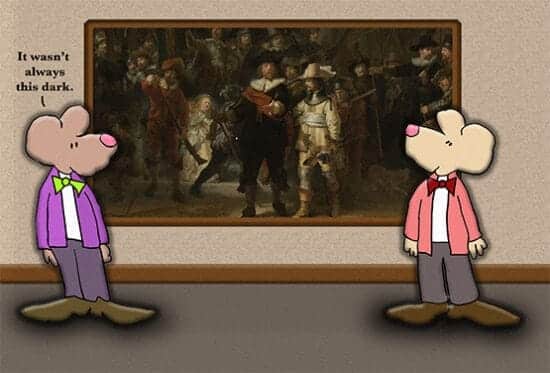
The Night Watch by Rembrandt. Despite the name, The Night Watch shows a daytime militia parade. The dark look came later. This was thanks to layers of aging varnish and grime. The painting was created in 1642, and its original title was: “The Company of Captain Frans Banning Cocq and Lieutenant Willem van Ruytenburch.”
The Scream by Munch. Get this . The figure in The Scream isn’t really screaming. That open-mouthed figure is actually reacting to a scream in nature. It is like their mouth is agape and not producing a scream at all. Munch wrote about feeling a vast scream pass through the landscape. The figure is covering its ears to shield itself from the scream it hears.
Washington Crossing the Delaware By Emanuel Leutze.Washington probably didn’t ride his boat like that. The painting shows George Washington standing heroically at the bow of a boat. But let’s face it. In reality, the crossing happened at night, in freezing conditions. Standing like that would’ve been wildly unsafe. And probably a little impossible. He was probably hunkered down inside.
These things tell us that old thing once again. You can’t judge a book by its cover. Or the story of painting by its appearance. Paintings aren’t photographs. They’re interpretations. They are stories told with the imagination. And sometimes the truth is more interesting.
“”””””””
“Art is not what you see, but what you make others see.”— Edgar Degas
“”””””””
“We don’t see things as they are, we see them as we are.”— Anaïs Nin””””””””
“”””””””
“The painting has a life of its own.”— Jackson Pollock
“”””””””
“The eye sees only what the mind is prepared to comprehend.”— Henri Bergson
“”””””””